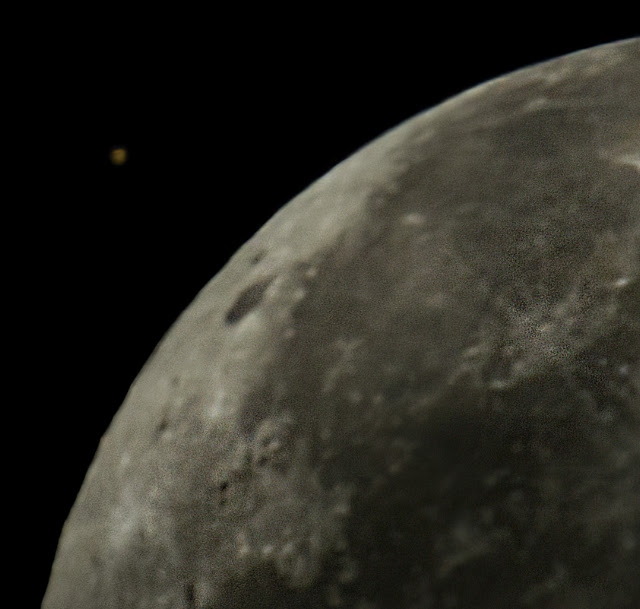
Not the best photo in the world but hey, it's Venus in a waxing gibbous phase. I've been watching it slowly rise higher in the western sky since just after Christmas and I've seen it in close proximity to Jupiter and the Moon. Hopefully I'll manage a better shot when it's higher still.
Monday, 27 March 2023
Saturday, 25 March 2023
Waxing Crescent Moon
Unfortunately the weather has been very poor in recent weeks and this is the first time I've seen the moon in ages. The cloud cover meant that I couldn't see the thin sliver of moon which appears after a new moon and so I'll just have to be content with this crescent which is a few days old now.
Tuesday, 7 March 2023
Abandon All Hope Ye Who Enter Here - Dante's Inferno!
Well, may be not quite, but when I process an Ha-rich image of the Orion Nebula like the one above, it always makes me think of it. This is a starless version, which some people prefer to images which are covered in stars, often overpowering the delicate features of the nebula. Personally, I like some stars in an image as without them I think it seems a little artificial. So I'll often do a bit of star reduction to make them as little less dominant and distracting. Here's a version with some stars and :
And here's a much wider version showing the Running Man Nebula a little better:
Monday, 6 March 2023
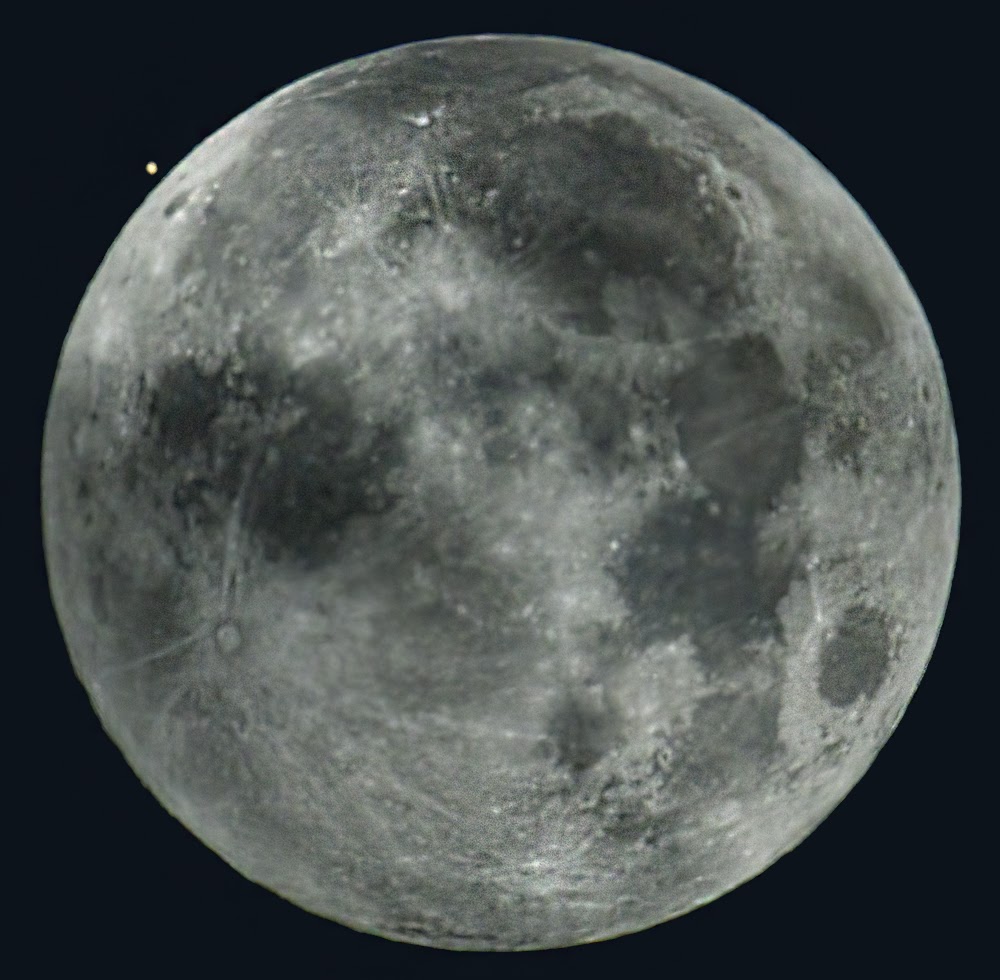
Howling at The Wolf Moon
As I have said many times here in my blog and in several other online places, the full moon is my least favourite time to take moon shots. Because the sun is pointing straight at it (and thus lighting up the whole nearside of the moon) the light is very fast with no shadows and little detail. It takes a bit of work to bring out some of the detail and it doesn't always work. Having said that, it doesn't stop me from trying!
I personally think that the full moon is best when used as part of a composition, something like this shot on the previous day. The trouble then is finding a good location for some foreground interest or scenes value. I'm still looking for that.
Thursday, 2 March 2023
Venus and Jupiter Meet
Venus and Jupiter were close in the western sky tonight. Well they looked close by eye, but when a photograph is taken with a long telephoto lens they appear to be quite a long way apart. The whole thing is an illusion anyway and in reality they are millions of miles apart and Jupiter is 10x bigger that Venus. This is also true of many the stars we see in our constellations - they seem to form a 2D pattern in the sky, when in 3D reality they are nowhere near each other.
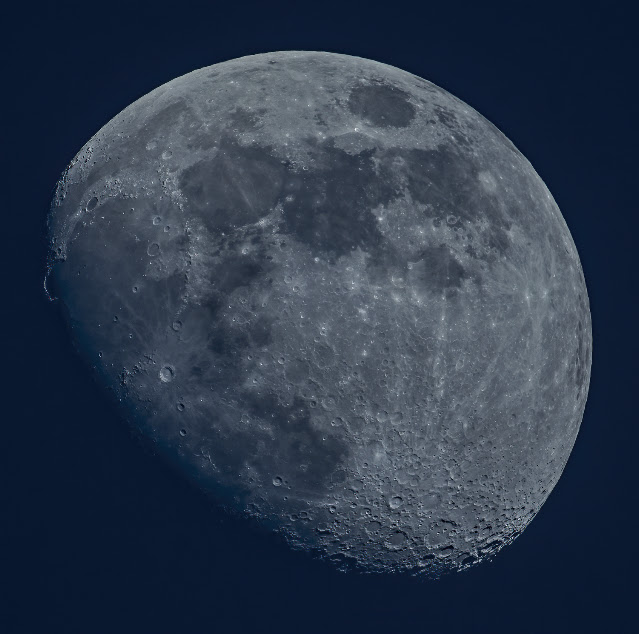
Daytime Waxing Gibbous Moon
This shot was taken whilst it was still light in the 'Blue Hour'. There is some good detail in the lower right quadrant but not much along the terminator line as this is mainly over two large Maria.
Tuesday, 27 December 2022
Review of 2022
Some of my better images from 2022. I didn't think I done that much this year, having focused mainly on planetary imaging, but in the early part of the year I did do some work on nebulae.
From left to right and top to bottom we have:
- The California Nebula, which supposedly resembles the shape of the state
- Mars showing its north polar ice cap of frozen carbon dioxide
- The Flaming Star anthem Tadpole Nebulae with the smaller small spider Nebula
- Saturn when it was close to opposition
- The famous Horsehead Nebula and with the Flame Nebula below it
- Jupiter showing cloud bands
- The Jellyfish Nebula
- A so-called 'mineral' moon
- The Christmas Tree Nebula with the Cone Nebula st the top
- The sun showing at least seven active regions or sunspots
- The Soul Nebula
- The Rosette Nebula in the false Hubble Palette colour
Tuesday, 20 December 2022
To Do List (20/12/22)
I'll start my updates by creating a to do list of my images since March 2022 in reverse chronological order.
December 2022
- Rosette Nebula
- Orion Nebula
- Sunspots
- Moon
- Jupiter (2/10/22)
- Mars (inc lunar occultation)
- Saturn
November 2022
- Andromeda Galaxy (25/11/22)
- Heart Nebula
- North America Nebula
- Moon
- Jupiter
- Saturn
- Mars
- Uranus Occultation
- First Andromeda - wide
October 2022
----------------------------------------------------------
Photos still to post:
Sept
- Astro 17/9
- Jupiter 16/9
- Moon and Planets 15/9
- Sunspots 7/9
- Llanddwyn 7/9
Aug
- Moon 24/8
- Moon 25/8
- Moon 27/8
- Moon and Planets 26/8
- Moffat 10/8
- Jupiter, Saturn &DSO's 12/8
- DSO and Planets 2/8
- Dunstan Hill 9/8 and 13/8
- Sunspots 29/8
- Jupiter and Saturn 27/9
July
- Pacman and Veil nebula 18/7
- ISS and Moon 19/7
- Elephant's Trunk 17/7
- ISS, Jupiter and Saturn 17/7
- ISS and Moon 16/7
- Moon 15/7
- Dumbell 15/7
- Crescent 16/7
- Andromeda 8/7
- Eagle Nebula 7/7
June
- Sunspots 29/6
- Moon, Saturn and Jupiter 26/6
- NGC 7000 26/6
- Moon 21/6
- Moon 20/6
- Moon 17/6
- Moon and Antares 15/6
- Moon 14//6
- Partial Solar Ecli[se 10/6
May
- Sun
- Moon
- Rivi
- ISS
UPDATE TIME !!!
I can't believe that I haven't updated this blog since March 2022 - how time flies. Unfortunately it's not been a very productive year mainly due to the long stretches of poor weather and opportunities only arising at inopportune moments.
The main thing that happened this year was that I bought a second hand Celestron NexStar 6SE telescope, a ZWO ASI 224 planetary camera, a ZWO atmospheric dispersion corrector (ADC) and a 2.5x PowerMate (Barlow) for planetary work and so that's what I've mainly focused on for much of the year. It's been another learning curve as planetary imaging is quite unlike deep sky imaging, but I have had some successes and I've managed to produce my best ever images of Saturn, Jupiter and Mars. Still a lot of work to do there though.
In the last couple of months I've been very fortunate to have had the loan of a William Optics WhiteCat 51 widefield telescope off my friend and fellow L.A.S. member Mark Hellaby, who has very kindly let me borrow it for quite a while now as he focuses on other projects in his newly built observatory. I was mainly hoping to put it to good use at a 'Star Party' in darkest Dumfries and Galloway in November, but very poor weather meant I only managed one night of imaging and one target, Andromeda (shown here). However, since returning home I have had a few more sessions with it in my back garden and improved my existing images of several widefield deep sky objects.
So, without more ado, I'll set about updating this blog with images I've taken since March and I'll be putting them in chronological order according to the dates I took them.
Friday, 16 December 2022
At Time of Increasing Solar Activity
Here are today's active solar regions (A.R.'s) showing more sunspots than I'ver captured before. Although the sun emits all wavelengths of light and these combine to make white light, people are used to seeing the sun with an orange colour (caused by the scattering of all the shorter wavelengths but the atmosphere) and so I have increased the white balance to make it appear orange rather than the normal white colour my solar filter produces.
Here are some closer versions of the main sunspot groups being seen today:
| A.R. 3163, A.R. 3166 and A.R. 3162 |
| A,R. 3167 and A.R. 3160 |
| A.R. 3165 |
| A.R. 3168 |
| A.R. 3163 |
| A.R. 3166 and 3162 |
Thursday, 15 December 2022
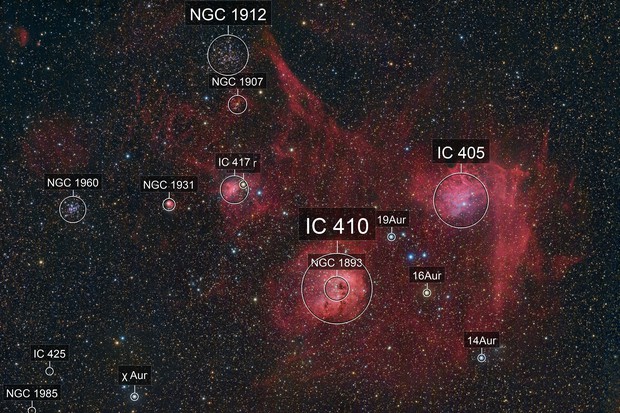
The Flaming Tadpoles and Friends
In the bottom right corner there is also part of NGC 1912 or the Starfish open star cluster.
Here's an annotated inverted version of this region of the sky:
Wednesday, 14 December 2022
The Full Veil Nebula
Until I borrowed the WO WhiteCat telescope with a focal length of 250mm, I could only ever image one section of the Veil Nebula at a time. To get the full Veil Nebula with my scopes I would need to do a mosaic of several images and I haven't got round to trying this technique out yet. Indeed, this is a common problem for many astrophotographers and so it's very common to see separate images of just the Western Veil (or Witch's Broomstick) and the Eastern Veil rather than the full nebula. Therefore the full Veil Nebula was high up on the list of images I wanted to take whilst I still had access to this scope.
Tuesday, 13 December 2022
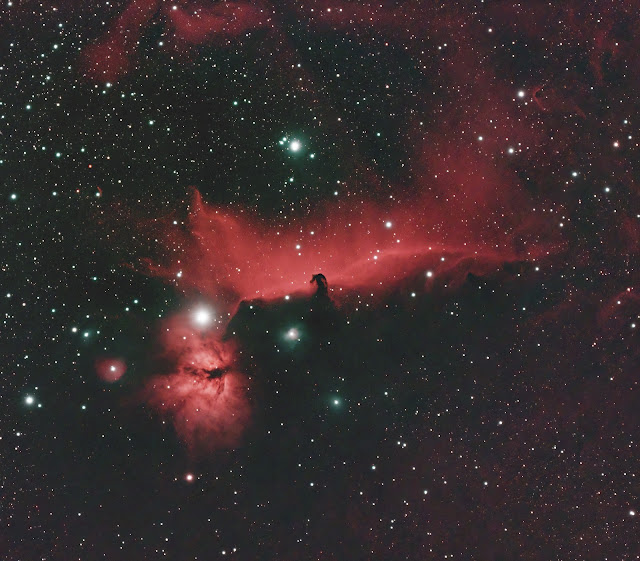
Two for the Price of One!
The famous Horsehead Nebula is one of my favourite deep sky targets and one I found it hard to believe I could actually image from my own back garden. And when imaging this dark nebula in widefield, you get two for the price of one, because the Flame Nebula is also in view in the lower left corner.
The big problem with imaging this fantastic pair of nebulae is the very bright star called Alnitak to the left of the horse's head, which tends to drown everything out. In trying to dim it's effect, there is a tendency for it to become quite dull, as it has done in my image above, so more work is needed to get the final image I so desire for my wall.
Thursday, 8 December 2022
The 2022 Lunar Occultation of Mars
Occultation is where one astronomical object, such as a planet or moon, passes front of another one, obscuring it from being seen. In this case, the Moon was due to pass in front of Mars in the early hours of 8 December 2022. In addition, Mars also happened to be in opposition, meaning that the Earth was directly in line between Mars and the Sun. Opposition is when a planet appears at its brightest in the night sky.
I had so looked forward to this rare astronomical event and planned for it quite throughly, but in the end I was frustrated and foiled by the cloudy weather. I set up early in the afternoon and had quite a few practice shots during the early evening when the skies here were crystal clear.
At first I thought I'd stay up all night waiting for the main event when Mars was occulted by the full 'Cold' Moon at around 4:45am, but in the end I decided to get a few hours sleep starting around11:45pm. When I got up at 3:14am, the skies were still clear and Mars was a lot nearer to the moon than when I had gone to bed. However, when I returned from making a quick cup of tea, everything had changed!
The clouds had rolled in totally obscuring Mars and the Moon at times and time was running out. I'd focused everything previously, so I wasn't concerned about that, but the exposure time was giving me real problems and I had to keep adjusting it manually with every passing cloud. This really wasn't easy and was certainly very frustrating.
Consequently, I couldn't see Mars at the all important moment of occultation, so I just left the camera video running whilst I hoped for the best. I was also trying to take some manual single shots with my DSLR and big lens in a sort of belt and braces approach. In hindsight this wasn't such a good idea as my attention was constantly switching between the two systems.
At first I thought I'd totally fluffed it, but with a considerable amount of processing I managed to resurrect these two shots from the stacked video. They're quite disappointing really but they are all I've got and at least I witness the event.
My best shot probably came after the occultation had finished and Mars was on its way to set in the western sky. You can see how cloudy it was from the colours in the sky and the lack of clarity in the Cold Moon's surface features.
Tuesday, 6 December 2022
If You've Got Heart, You Gotta Have Soul!
The Soul Nebula is partner to the Heart Nebula in the constellation of Cassiopeia. The Heart Nebula was my first go at using Mark Hellaby's WhiteCat 51 telescope last month. Unfortunately, not even the WhiteCat is wide enough to capture both in one image and so I had to image them separately. Tonight's target was the Soul Nebula - well, if you've got Heart, you gotta have Soul!
I also managed a bit of time on the Elephant's Trunk Nebula on the same night. It's nice to see it in a widefield setting as my previous images wit a narrower field of view concentrate just on the Elephant's Trunk itself.
Sunday, 13 November 2022
The North America and Pelican Nebulae in Cygnus
You're All Heart
My previous attempts at the Heart Nebula have never managed to capture the whole nebula due to my own scopes having to narrow a field of view (FOV). However, Mark Hellaby has kindly loaned me his William Optics WhiteCat 51 telescope which, at 250mm, has a much wider FOV and so I am able to image some of the larger nebulae in their entirety. My first go at using this excellent scope was to image the Heart Nebula.
And it really does look like a science textbook cross section of the human heart!
Sunday, 27 March 2022
Catching up with Messier 109 - A Spiral Galaxy
Friday, 25 March 2022
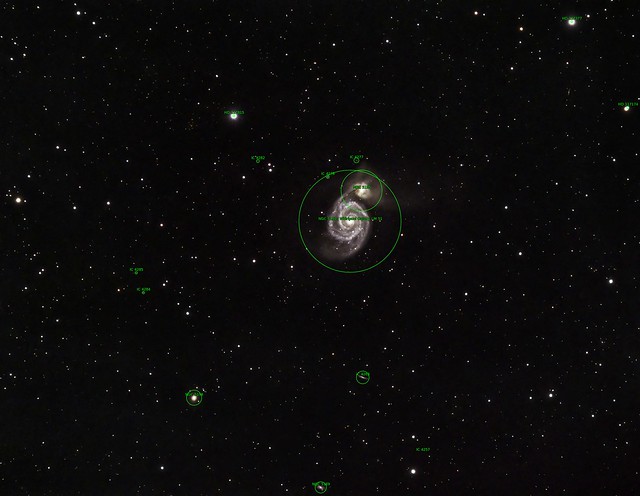
Messier 51a - The Whirlpool Galaxy
The advent of radio astronomy and subsequent radio images of M51 unequivocally demonstrated that the Whirlpool and its companion galaxy are indeed interacting. Sometimes the designation M51 is used to refer to the pair of galaxies, in which case the individual galaxies may be referred to as M51a and M51b.
The galaxy and its companion, NGC 5195, are easily observed by amateur astronomers, and the two galaxies may be seen from dark sky sites with binoculars. The Whirlpool Galaxy has been extensively observed by professional astronomers, who study it to understand galaxy structure (particularly that associated with the spiral arms) and galaxy interactions. This second version of my image is one that has been calibrated photometrically in Siril to give the true star colours.