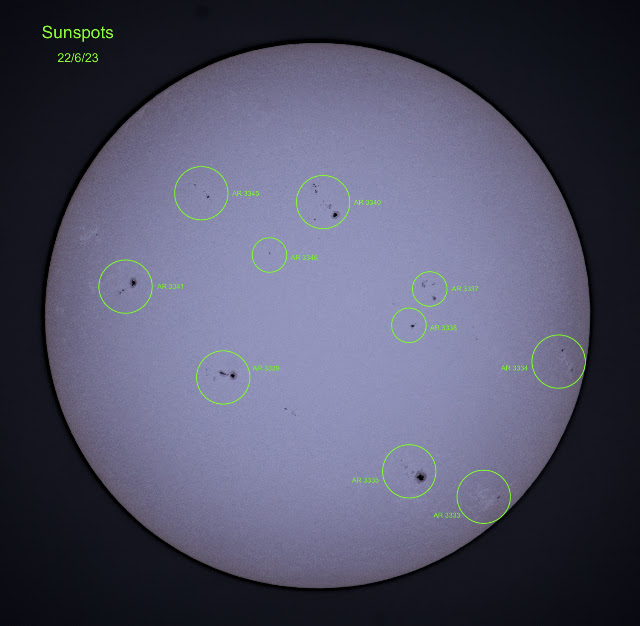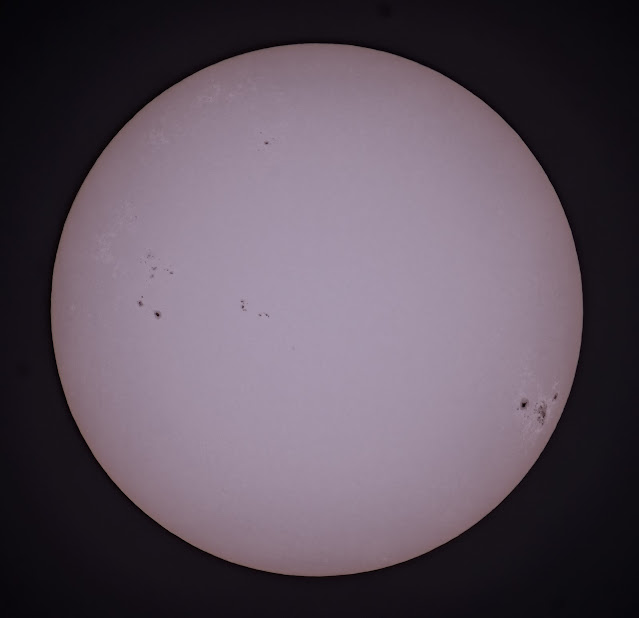

Here are today's active solar regions (A.R.'s) showing more sunspots than I'ver captured before. Although the sun emits all wavelengths of light and these combine to make white light, people are used to seeing the sun with an orange colour (caused by the scattering of all the shorter wavelengths but the atmosphere) and so I have increased the white balance to make it appear orange rather than the normal white colour my solar filter produces.

Here are some closer versions of the main sunspot groups being seen today:
 |
| A.R. 3163, A.R. 3166 and A.R. 3162 |
 |
| A,R. 3167 and A.R. 3160 |
 |
| A.R. 3165 |
 |
| A.R. 3168 |
 |
| A.R. 3163 |
 |
| A.R. 3166 and 3162 |
Today I have been mainly photographing an International Space Station's Solar Transit. This is when the ISS passes across the face of the sun creating a silhouette of its shape. Whether you can view a solar transit like this depends on where you are on earth at the time of its passing. Luckily, today it was viewable from some parts of the UK.

Planning


From the above image it can be seen that when I was planning this, the next solar transit was 2020-12-05 (US date format) which is today. However, the quality of view was only going to be 2 star from where I live in Tyldesley with only 1.21 seconds of viewing time and the ISS is only just skirting the bottom of the sun. Clicking on the 'MORE INFORMATION' button revealed more detail:

Clicking on 'SHOW ON MAP' produces a map of the transit path showing my location as a red pin and an ideal location on the line of maximum viewing time with a green pin.

Anywhere along the central line would give a viewing of 2.37 seconds. So I closed the pop up box and zoomed into the map to find a good spot. It was at this point that my friend Paul Richardson suggested Dunham Massey, as it's an area not far from our homes and almost exactly on the central line. He suggested a free car park on Henshaw Lane, but when I actually got there it wasn't in the best position. However, I soon found another spot just 100 metres up the road and Paul joined me there.

Preparation
The preparation to get an image of the solar transit mainly requires a lot of thought. There are two main methods I considered:


With the skies being cloudy at night for sometime now and, with the recent development of some decent solar activity, my thoughts turned to the sun this afternoon. I didn't give myself much time as it was rapidly going down behind the neighbouring houses, but I did manage to get a couple of shots of the current active region known as AR 2781.
Sunspots are temporary solar phenomena which are regions of reduced surface temperature caused by concentrations of magnetic field flux that inhibit convection. They are darker than the surrounding areas and occur in a region called the photosphere. Whereas the photosphere has a temperature of 5,800 degrees Kelvin, sunspots have temperatures of about 3,800 degrees K. They look dark only in comparison with the brighter and hotter regions of the photosphere around them and they usually appear in pairs of opposite magnetic polarity as well as moving across the sun's surface.

The designation AR stands for Active Region and the sunspots shown in these photos are part of the current Solar Cycle 25. NASA had this to say on their website:
Solar Cycle 25 has begun.
The Solar Cycle 25 Prediction Panel, an international group of experts co-sponsored by NASA and NOAA, announced that solar minimum occurred in December 2019, marking the start of a new solar cycle. Because our Sun is so variable, it can take months after the fact to declare this event. Scientists use sunspots to track solar cycle progress; the dark blotches on the Sun are associated with solar activity, often as the origins for giant explosions – such as solar flares or coronal mass ejections – which can spew light, energy, and solar material into space.
Here's a cropped version of the above photo to show the sunspots in a little more detail:

The Baader AstroSolar Safety Film I used to make the filter renders the image as more or less white, and indeed, this is the true colour of the light coming from the sun. The orange hues we see by eye are mainly due to dust in the atmosphere, although some specialised filters do give the images a deeper orange colour. Here's a simulation of that created by simply increasing my camera's white balance control.