Not the best photo in the world but hey, it's Venus in a waxing gibbous phase. I've been watching it slowly rise higher in the western sky since just after Christmas and I've seen it in close proximity to Jupiter and the Moon. Hopefully I'll manage a better shot when it's higher still.
Showing posts with label Venus. Show all posts
Monday, 27 March 2023
Thursday, 2 March 2023
Venus and Jupiter Meet
Venus and Jupiter were close in the western sky tonight. Well they looked close by eye, but when a photograph is taken with a long telephoto lens they appear to be quite a long way apart. The whole thing is an illusion anyway and in reality they are millions of miles apart and Jupiter is 10x bigger that Venus. This is also true of many the stars we see in our constellations - they seem to form a 2D pattern in the sky, when in 3D reality they are nowhere near each other.
Wednesday, 29 April 2020
Tonight's Moon - 29/4/20
Tonight's single shot of the moon (29/4/20). I've decided that most of my previous moonshots have been taken using the wrong white balance. I can reprocess them to correct this, but I don't think I'll bother - there'll be plenty more moons in the sky!
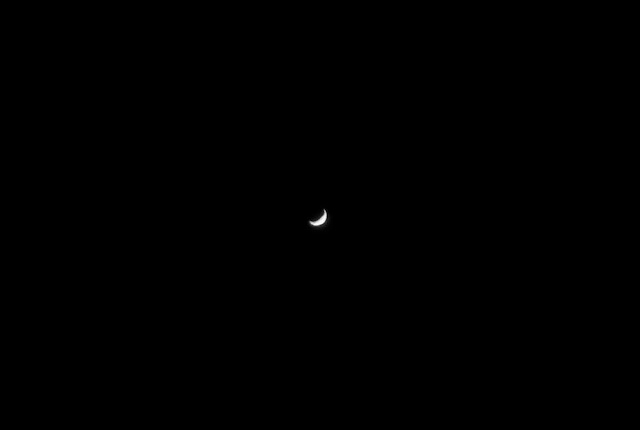
Venus is a lot harder to photograph my camera gear. It's very bright, very small and a long way away. Here's the best I can currently do. At least, being a crescent shape, it shows it has phases like the moon. Only Mercury, Venus and the Moon show full phases like this, because they are between the Earth and the Sun. Mars shows some partial phases I believe.
Sunday, 5 April 2020
Venus and the Pleiades
Venus and the Pleiades - sounds like the name of a pop group doesn't it? Well this was going to be one of the highlights in the night sky this month and so I was very keen to photograph it.
Frustratingly, the clouds rolled in on best night when Venus would be in front of this open star cluster (3/4/20), so I had to make do with the following night (4/4/20).
I started by taking some photos of the waxing gibbous moon before it went completely dark. There are nice views of the Tycho and Copernicus lunar impact craters here. It was from this photo that I realised how far the ejection debris was flung from Tycho after it was hit by a large meteorite.
Venus was my next target, also before it went fully dark. I wanted to try to show its phase as it is rapidly diminishing in size and look very crescent-like. I had to turn the brightness down a long way to show it and this has made the sky look darker than it actually was.
Here's Venus with the Pleiades star cluster to the lower right. Whoever named this asterism the 'Seven Sisters' clearly couldn't see all the stars - there are many more than seven! Here's a quote shamelessly lifted from a post by Paul Richardson.
Frustratingly, the clouds rolled in on best night when Venus would be in front of this open star cluster (3/4/20), so I had to make do with the following night (4/4/20).
I started by taking some photos of the waxing gibbous moon before it went completely dark. There are nice views of the Tycho and Copernicus lunar impact craters here. It was from this photo that I realised how far the ejection debris was flung from Tycho after it was hit by a large meteorite.
Venus was my next target, also before it went fully dark. I wanted to try to show its phase as it is rapidly diminishing in size and look very crescent-like. I had to turn the brightness down a long way to show it and this has made the sky look darker than it actually was.
Here's Venus with the Pleiades star cluster to the lower right. Whoever named this asterism the 'Seven Sisters' clearly couldn't see all the stars - there are many more than seven! Here's a quote shamelessly lifted from a post by Paul Richardson.
Every eight years or so, Venus passes across the line of sight of the Pleiades star cluster. It's not exactly passing "through" the star cluster, since the Pleiades are about 88 thousand times further away from us than Venus is. Since Venus is at present about 107 million Km away, that make the Pleiades a long way from home. Anyway this is how they looked last night. So mind boggling, but so beautiful.
Subscribe to:
Comments (Atom)