Showing posts with label waxing gibbous moon. Show all posts

Saturday, 12 October 2024

A Return to Mooning

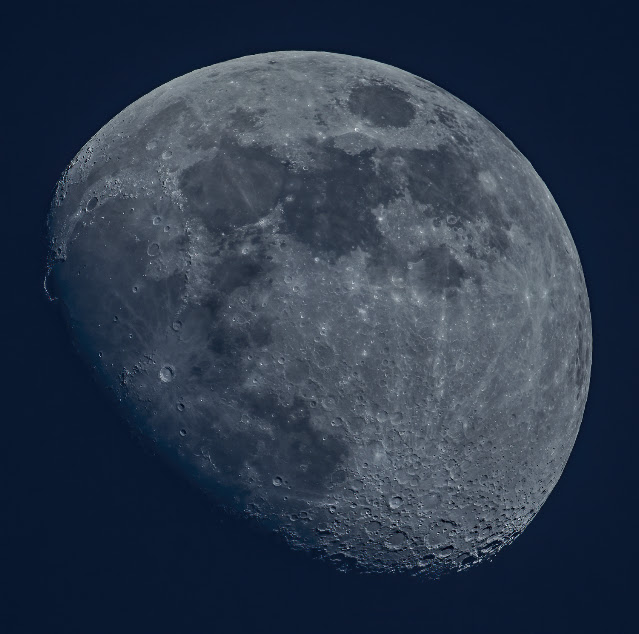
I went out comet-hunting last night but this was all I got due to heavy cloud in the west. 

The Waxing Gibbous Moon.


Acquisition Details 
  • Nikon D500 crop sensor camera with Nikon 500mm f/4 lens and 2x teleconverter 
  • Tripod with a gimbal head 
  • Single shot: 1/60s @ f/11 and ISO 100 
  • Processed in Adobe Photoshop Elements 2024 with Topaz AI DeNoise and Sharpen

Thursday, 2 March 2023

Daytime Waxing Gibbous Moon


This shot was taken whilst it was still light in the 'Blue Hour'. There is some good detail in the lower right quadrant but not much along the terminator line as this is mainly over two large Maria.

Sunday, 27 September 2020

International Space Station Fly Over

After being missing from our northern skies for a few months, the International Space Station (ISS) can now be seen again tracking west to east across the sky in our area.  I use an iPhone app called ISS Spotter to predict when the ISS will next be passing over and in which direction.

It seems that some people don't think it's possible for me to take shots like this, but I can assure you it is.  I use a Nikon D500 crop sensor camera with a Nikon 500mm f/4 lens and a Nikon 2x teleconverter.  The above shot is cropped to death and fortunately, with a bit of processing, the detail isn't too bad.  Here's what an uncropped version looks like (which actually might be better):


Here's a shot of the waxing gibbous moon that I also took:

Tuesday, 5 May 2020

Waxing Gibbous Moon, Again! (4/5/20)

Here's a shot of last night's waxing gibbous moon, but with a difference. I've tried using PIPP to convert a short video of the moon into separate TIF files which can then be stacked in AutoStakkert3, but without much success.  I seem to get much better results from single shots only processed in Photoshop. This image is a stack of eight separate shots blended together using only Photoshop.   However I must admit that this one looks a tad sharper than the single shot shown below it, although it has gained a bit of a purple tinge, which I can remove if necessary.


Below is just one of the single shots used to make the above image:


The stacking process I used in Photoshop was as follows:
  1. Choose File>Scripts>Load Files into Stack
  2. Click Browse and select all the files you want to stack together
  3. Tick the 'Attempt to Automatically Align Source Images' checkbox and then OK
  4. Then in Photoshop, select all the layers
  5. Choose the 'Lighten' blend mode.
  6. Process further if required and then save.

Saturday, 2 May 2020

Y.A.M.S.

Y.A.M.S. stands for Yet Another Moon Shot.  I often take shots of the moon when other plans have gone by the wayside. It's always a good fallback. Tonight I had planned to do a full evening of Deep Sky Object (DSO) shots because this afternoon the weather looked to be set fair for a while. But things don't always go to plan, do they?

The moon appeared early in the afternoon as a very faint object in the sunny blue sky, so I really had to ramp up the contrast and brightness to get anything worth looking at. I suspect you will either love or hate this image of the daytime moon.

Afternoon Moon (2/5/20)
After it had gone dark I started taking a few shots with my big telescope (which I am still getting used to) and the guide camera which can also be used as a planetary camera. I was pleased to have some success with this as the guide camera produces much closer images than my normal cameras do. I waited for Polaris to appear out of the clouds that had rolled in so that I could polar align my mount and get on with tonight's main business.

I waited, and waited and ... waited, but the clouds didn't lift. So I just kept taking a few more moon shots in the hope that it would lift eventually. By 11pm it had got colder and damper and there was dew beginning to form on the grass, so I decided that would be it for the night.  Of course, after I had packed everything away, the sky started to clear again, but by then I'd had enough and I decided that I just process what I'd got and call it a night.  Here's the first of them and more will follow tomorrow.

Waxing Gibbous Moon (2/5/20)

Friday, 1 May 2020

Tonight's Moon (1/5/20)

Tonight's waxing gibbous moon with various processing methods applied. Can you see any real difference - which do you prefer?


I wondered that if I cropped the shots into two halves, would the detail be clearer in each section?


I also thought it might be a good idea to dig out this old moon map I made a few months ago:


Sunday, 5 April 2020

Venus and the Pleiades

Venus and the Pleiades - sounds like the name of a pop group doesn't it? Well this was going to be one of the highlights in the night sky this month and so I was very keen to photograph it.

Frustratingly, the clouds rolled in on best night when Venus would be in front of this open star cluster (3/4/20), so I had to make do with the following night (4/4/20).


I started by taking some photos of the waxing gibbous moon before it went completely dark. There are nice views of the Tycho and Copernicus lunar impact craters here. It was from this photo that I realised how far the ejection debris was flung from Tycho after it was hit by a large meteorite.


Venus was my next target, also before it went fully dark. I wanted to try to show its phase as it is rapidly diminishing in size and look very crescent-like. I had to turn the brightness down a long way to show it and this has made the sky look darker than it actually was.


Here's Venus with the Pleiades star cluster to the lower right.  Whoever named this asterism the 'Seven Sisters' clearly couldn't see all the stars - there are many more than seven!  Here's a quote shamelessly lifted from a post by Paul Richardson.
Every eight years or so, Venus passes across the line of sight of the Pleiades star cluster. It's not exactly passing "through" the star cluster, since the Pleiades are about 88 thousand times further away from us than Venus is. Since Venus is at present about 107 million Km away, that make the Pleiades a long way from home. Anyway this is how they looked last night. So mind boggling, but so beautiful.

Monday, 7 October 2019

Waxing Gibbous Moon - 7 October 2019


The waxing gibbous moon as seen from my front garden in Tyldesley. Waxing means that it's getting bigger. Gibbous refers to the shape, which is less than the full circle of a full moon, but larger than the semicircle shape of the moon at third quarter.