Showing posts with label Rosette Nebula. Show all posts

Wednesday, 5 April 2023

A Swift Session at the Rosette and Heart!

I popped out to the Rosette and Heart for a swift session last night!  It's been so long since I've done any deep sky imaging (due to the appalling night time UK weather) that I've forgotten almost everything about how to do it! I also thought I'd use the session to reacquaint myself with guiding as I haven't used it that often and up to a point it was a successful trial

So here's a couple of narrowband images from last night to help ease myself back into the game. I started with the Rosette Nebula (Sh2-275 or Caldwell 49), the centre of which contains the open star cluster NGC 2244 or Caldwell 50.  It's an H II region located near one end of a giant molecular cloud in the Monoceros region of the Milky Way. The open star cluster is closely associated with the nebulosity, the stars of the cluster having been formed from the nebula's matter.

The Rosette Nebula has been said to resemble a human skull, and is sometimes referred to as the 'Skull Nebula' although in this image the skull has been rotated 90 degrees to 'look' upwards.


My second target was the Heart Nebula (IC 1805 or Sh2-190) in the constellation of Cassiopeia which is another emission nebula, and was discovered by William Herschel on 3 November 1787. It displays glowing ionized hydrogen gas and darker dust lanes.

The brightest part of the nebula (a knot at its western edge) is separately classified as NGC 896, because it was the first part of the nebula to be discovered. The nebula's intense red output and its morphology are driven by the radiation emanating from a small group of stars near the nebula's center. This open cluster of stars, known as Collinder 26 or Melotte 15, contains a few bright stars nearly 50 times the mass of the Sun, and many more dim stars that are only a fraction of the Sun's mass.

The Heart Nebula is also made up of ionised oxygen and sulphur gasses, responsible for the rich blue and orange colours seen in some narrowband images. The shape of the nebula is driven by stellar winds from the hot stars in its core. The nebula also spans almost 2 degrees in the sky, covering an area four times that of the diameter of the full moon.
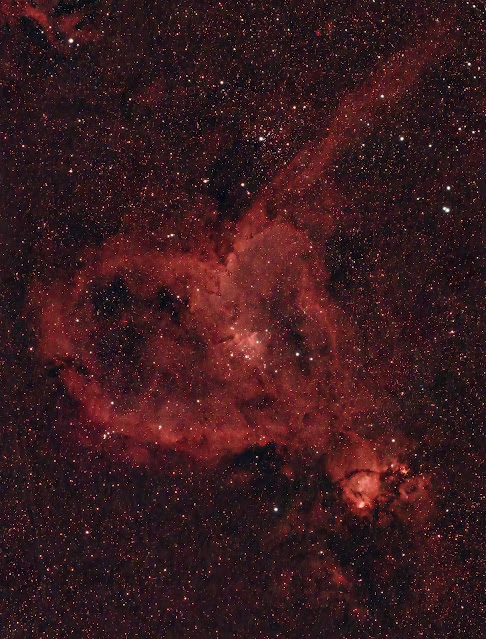

Acquisition Details
  • William Optics WhiteCar 51 (kindly lent by Mark Hellaby)
  • Sky-Watcher EQ6-R Pro equatorial mount
  • Altair Astro 294C Pro Tec cooled colour camera
  • Optolong L-eNhance narrowband filter
  • Partly guided by PHD2 using a ZWO 224mc on a Sky-Watcher finder scope
  • Captured in Astro Photography Tool
  • Stacked and light pollution removal in Astro Pixel Processor
  • Processed in Adobe PhotoShop with Topaz AI Denoise, Sharpen and AstroFlat plugins and Astronomy Tools actions

Thursday, 17 December 2020

Rosette Nebula Revisited

With unexpected clear skies last night, I decided to have a 'proper' go at imaging the Rosette Nebula which has the NGC 2244 star cluster at its core. Things didn't quite go to plan as I made a mistake with my intervalometer and so wasted an hour of imaging time, but I did manage to get something out of the evening. Here is the equipment and acquisition data along with the resulting image:

Equipment used:
  • SkyWatcher EvoStar 80D with Skywatcher 0.85x focal reducer
  • Canon 800D modded for Ha sensitivity
  • Optolong L-eNhance narrowband filter
  • MGEN-II standalone autoguider on 9x50mm SkyWatcher finder scope
  • SkyWatcher HEQ5 Pro mount with belt mod
Acquisition details:
  • 7 x 5 minute subs with similar dark, flat and bias calibration frames.
  • Processed in Siril followed by Adobe PhotoShop CC

As you can see, I've added my GeekTeacher Astro signature logo to this image.

Tuesday, 3 November 2020

First Light with my Astro-modded Camera and Narrowband Filter

My recent acquisition for doing astrophotography is a Canon 800D DSLR camera body which I had modified for astro work. Now I am a Nikon user and it pained me to buy a Canon camera, particularly when I have two older Nikon bodies which could have been used.  However, three factors influenced my decision to buy a Canon body. Firstly, it is ridiculously expensive to have a Nikon camera modified for astrophotography in the UK and very few places do it. Secondly, neither of my old Nikons have a swivel screen and I have found having this on my D500 invaluable.  But I'm not going to have that body modded as it's my main birding camera. Thirdly, I know several people who use this model of camera to good effect and it's still a current model.

The modification involves removing the infra red (IR) filter (which is fitted to most new cameras) in order to make it more sensitive to the Hydrogen Alpha (Ha) wavelengths of light.  Many deep sky objects emit Ha light and normal DSLRs find it difficult to image these wavelengths.

In addition, I recently bought an Optolong L-eNhance narrowband filter to cut out unwanted light-pollution from houses, street lights and the moon as well as improving the contrast of Ha emission nebulae.  But when I took some initial shots with it on my unmodified Nikon camera, I realised it wasn't going to work well.  So I ended up buying a second hand camera body to have modified for increased sensitivity.

This session was my first attempt at using both the filter and modded camera together, and I have to say I am pretty pleased with the results.

My first target was NGC 2244, the Rosette Nebula in the constellation of Monocerous near to Orion. Although the initial image didn't look like this, I could definitely see the red Ha light faintly on the back of the camera and processing it in PhotoShop CC brought out these details.  It is a single shot of 7 minutes duration at ISO 800 on an HEQ5 Pro tracking mount. I didn't use guiding and so the stars are amazingly round for this duration of shot.


Later I took this shot of IC 1805, the Heart Nebula in the constellation of Cassiopeia and, although I should have used a focal reducer to get the whole image in the frame, I am pleased with my first attempt. The exposure was the same for the Rosette Nebula as described above.


With these two successful targets under my belt I am now keen to get guiding going and do some stacked sets of shots to hopefully bring out more fine detail and perhaps some more colours.  I'll also be using a focal reducer on both of them next time.