Showing posts with label Full Moon. Show all posts

Thursday, 17 October 2024

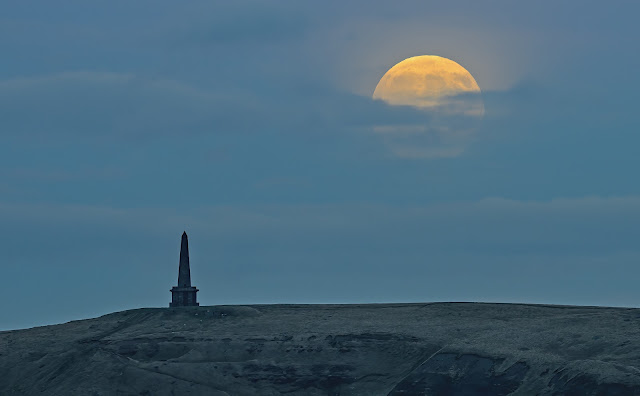
Hunter's Moon Over Stoodley Pike in West Yorkshire

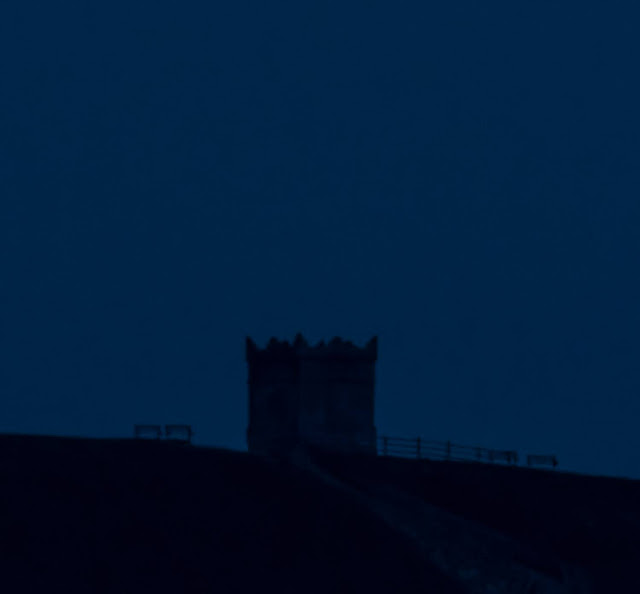
Stoodley Pike is a 1,300-foot hill in the south Pennines in West Yorkshire in northern England. It is noted for the 121-foot Stoodley Pike Monument at its summit, which dominates the moors of the upper Calder Valley and the market town of Todmorden. 

The monument was designed in 1854 by local architect John Green, and completed in 1856 at the end of the Crimean War


Unfortunately this shoot didn't turn out as planned because when the supermoon was behind the Pike it was covered in cloud. What ya gonna do?

Monday, 3 July 2023

Sunday, 4 June 2023

Strawberry Moonscape

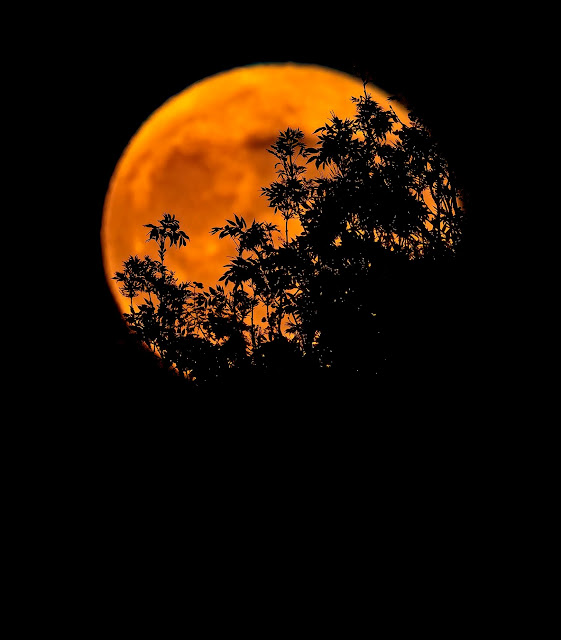
I went out tonight looking for a good location to photograph the full 'Strawberry' Moon.  Unfortunately  my ideas for locations didn't work out as I had hoped and so I had to settle for this image taken from the guided busway in Tyldesley looking south over Tyldesley, Astley and towards the mosses. The moon really was this colour due to being so low on the horizon and perhaps exacerbated by smoke from the wildfires currently burning in the US.


This was shot hand held and wasn't intentional, but I quite like it!


Monday, 6 March 2023

Howling at The Wolf Moon

As I have said many times here in my blog and in several other online places, the full moon is my least favourite time to take moon shots.  Because the sun is pointing straight at it (and thus lighting up the whole nearside of the moon) the light is very fast with no shadows and little detail.  It takes a bit of work to bring out some of the detail and it doesn't always work. Having said that, it doesn't stop me from trying!

I personally think that the full moon is best when used as part of a composition, something like this shot on the previous day.  The trouble then is finding a good location for some foreground interest or scenes value.  I'm still looking for that.

Thursday, 8 December 2022

The 2022 Lunar Occultation of Mars

Occultation is where one astronomical object, such as a planet or moon, passes front of another one, obscuring it from being seen.  In this case, the Moon was due to pass in front of Mars in the early hours of 8 December 2022.  In addition, Mars also happened to be in opposition, meaning that the Earth was directly in line between Mars and the Sun. Opposition is when a planet appears at its brightest in the night sky.

I had so looked forward to this rare astronomical event and planned for it quite throughly, but in the end I was frustrated and foiled by the cloudy weather. I set up early in the afternoon and had quite a few practice shots during the early evening when the skies here were crystal clear.  

At first I thought I'd stay up all night waiting for the main event when Mars was occulted by the full 'Cold' Moon at around 4:45am, but in the end I decided to get a few hours sleep starting around11:45pm. When I got up at 3:14am, the skies were still clear and Mars was a lot nearer to the moon than when I had gone to bed.  However, when I returned from making a quick cup of tea, everything had changed!

The clouds had rolled in totally obscuring Mars and the Moon at times and time was running out.  I'd focused everything previously, so I wasn't concerned about that, but the exposure time was giving me real problems and I had to keep adjusting it manually with every passing cloud.  This really wasn't easy and was certainly very frustrating.

Consequently, I couldn't see Mars at the all important moment of occultation, so I just left the camera video running whilst I hoped for the best.  I was also trying to take some manual single shots with my DSLR and big lens in a sort of belt and braces approach.  In hindsight this wasn't such a good idea as my attention was constantly switching between the two systems.

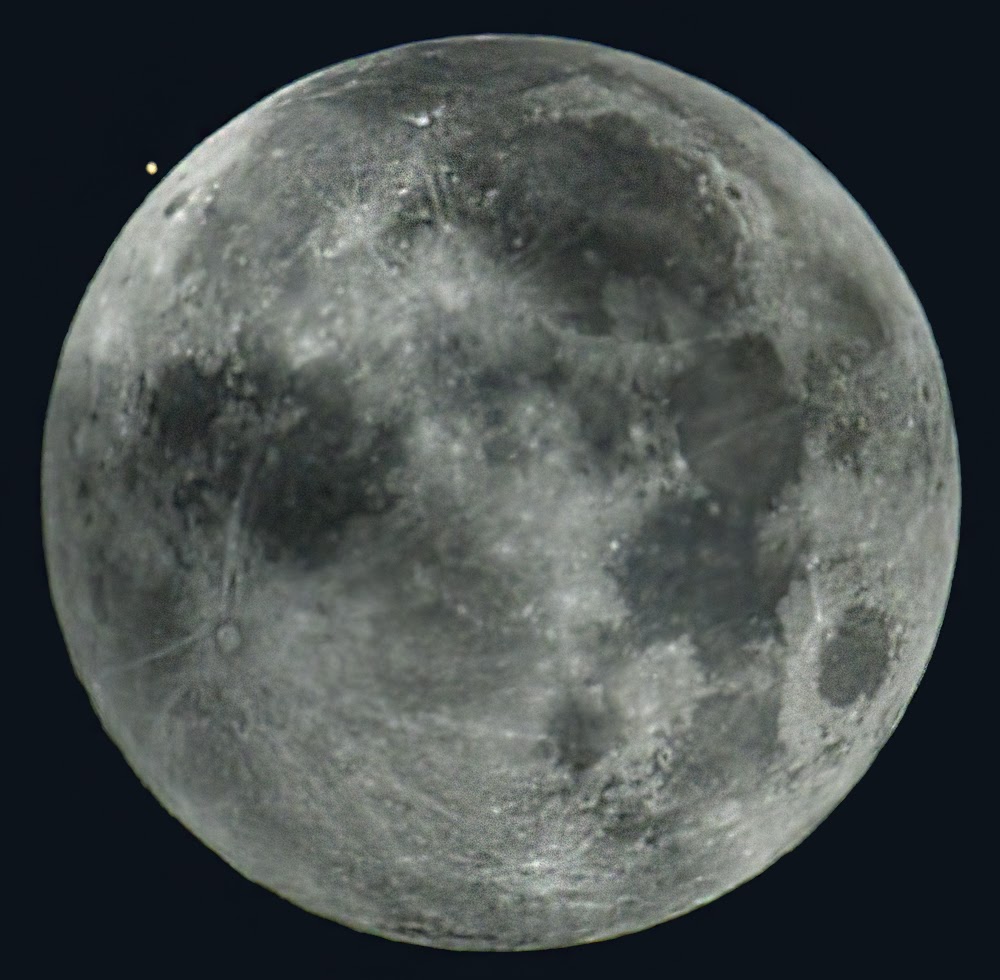
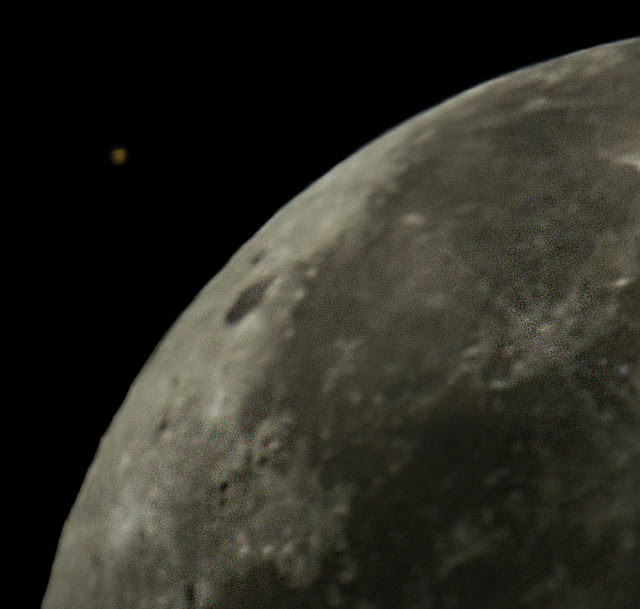
At first I thought I'd totally fluffed it, but with a considerable amount of processing I managed to resurrect these two shots from the stacked video.  They're quite disappointing really but they are all I've got and at least I witness the event.  


My best shot probably came after the occultation had finished and Mars was on its way to set in the western sky. You can see how cloudy it was from the colours in the sky and the lack of clarity in the Cold Moon's surface features.


Thursday, 27 May 2021

One Step Closer

Tonight I got one step closer to achieving the lunar image I desire from Rivington Pike.  My aim is to take a photograph of the full moon rising from behind the pike, with the Pike Tower on top being silhouetted against a large, bright moon.

I've tried a couple of times now and got it wrong on both occasions - however I learnt valuable things in doing so, and the most important thing is finding the right location from where to take the shot.  This may seem obvious, but it's nothing like as easy as it seems!

I used an iPhone app called PhotoPills to plan the shoot, because it tells me where and the moon will be rising each day and gives me an indication for the line of sight from where i will be able to see it.  Of course, it's not perfect as it can't foresee a stand of large trees or a mobile phone mast being in the way.

So armed with a few ideas, I drove up to Rivington at around 9:30pm to get set up and wait for the moon to rise at 11:13pm.  At this time of year it doesn't go completely dark and so, even with no street lighting or significant other lights, it's quite easy to see even in reasonably remote locations.

My first mistake was to realise that although the moon rises at a certain time, the times are for rising above the horizon -  being in the low west Pennine hills, there's no horizon in sight, and it takes much longer for it to appear above the hill tops. So I had another hour or so to wait after the time indicated.

During this waiting time the clouds came and went - at some point I could see stars and the Plough constellation and at other times I couldn't see anything.  The International Space Station passed overhead at around 10pm, but I was set up for the moon, so I didn't attempt to photograph it.

My second mistake was not to bring a torch because, even though I could see where I was standing and walking, finding the camera controls in the dark can be fiddly. I usually have a head torch with me but for some reason I didn't think to bring one tonight.

I took some test shots of the Pike Tower before it got near moonrise time and then waited, and waited, and waited. I actually started to wonder if it was so cloudy in the east that the moon had risen but I couldn't see it. 

Meanwhile, cars were whizzing by me at a fairly constant rate (it's the only road in this area), probably wondering what this lunatic (ged'dit?) was doing.  With my car up a slight verge at the entrance to a farm gate, I must have looked as if I had broken down, but only two cars stopped to see if I was OK, one of which held three beautiful young ladies (they looked like models), who asked me what I was doing and who were very interested to learn when I explained. Ah, if only I was 30 years younger!

Eventually the full moon did appear through hazy clouds, lighting up a patch of sky with an errie glow. It was a little more to the right of the Pike Tower than I wanted and so I lifted the tripod with the camera on it and walked further up the road.  The moon rises pretty quickly and by the time I'd got setup in a new location, it was higher in the sky. It was also much cloudier and so there was no chance of a decent shot tonight.

Never mind I thought, there's a full moon every month, although not a Supermoon like this one.  I was pleased to have got to my best location yet and now that I've found this, I can pop out again when the weather is better and I'm sure I'll eventually get the shot I want.

Wednesday, 26 May 2021

Super Flower Blood Moon

Super Flower Blood Moon (26/5/21)
This is the second and last of 2021’s two 'Supermoons' and it's also known as the 'Flower Moon' as it appears at the time that many flowers start to blossom.
A supermoon happens when a full moon occurs at the same time, or close to the time, that the moon reaches its closest point to the Earth – a point called perigee.
As well as being a supermoon, the moon also experienced a lunar eclipse (although not visible in the UK) giving it a reddish tinge and turning it into a so-called ‘Blood Moon’. 
A lunar eclipse happens when the moon’s orbit moves in front of the Earth’s shadow, preventing the sun’s light from reaching it – instead, light from the Earth’s sunrises and sunsets illuminates the moon, giving it its ‘blood’ red appearance. 
The hue and depth of the red colour is dependent on a number of factors, like the amount of dust in the atmosphere at the time of the eclipse. If there is a particularly high amount of dust in the atmosphere, the higher frequency blue waves will be blocked, allowing through the lower frequency ‘red’ coloured light waves. So the super blood moon’s appearance can range from a deep, fiery red to its regular grey self.
Supermoons appear to be bigger and brighter and this one will continue to look full to the naked eye for a couple of days on either side of May 26.

Thursday, 1 October 2020

The Moon and Mars in Conjunction - October 2020

October 2020 will have two full moons this year, the first being the Harvest Moon at the start of the month on 1 October and the second on Halloween, 31 October.  When this occurs, the second full moon is known as a  'Blue Moon' (nothing to do with its colour) and also 'Blood Mood', 'Sanguine Moon' or a 'Hunters Moon' - but more on than later, when it actually occurs.  For now, these names are all down to local folklore from various countries.

Along with the first Full Moon, Mars will be close to it as it gradually reaches opposition and so the aim here was to try and get the conjunction of Mars and the Moon in a single shot.  The weather was generally poor with a lot of cloud, but this actually helped in achieving an exposure which balanced out the Moon's brightness with Mars in the same frame.


I also tried a few shots of just the moon, but the cloud cover really didn't help the detail here.


I tried processing my shots in various ways, but none of them are really that successful.


Friday, 5 June 2020

Strawberry Moon in June 2020

The best I could do with last night's 'Strawberry Moon' (5/6/20).
Too cloudy and dull all night and this shot was taken through thin cloud.


It's called a Strawberry Moon because it coincides with when strawberries were originally harvested. Less common nicknames for this month's full moon, based on old European naming traditions, are the Mead Moon, Honey Moon, and Rose Moon.

Monday, 12 March 2018

Spring Equinox - the Last Supermoon of 2019

Having failed miserably to get an acceptable photo of Astley Green Colliery with the Supermoon in the background tonight, I've had to settle for just the moon on its own. Moonshots always look better with some foreground interest, like a building, mountain or E.T. riding a bike and full moons tend to look rather flat not having as much contrast as partial moons as there are no shadows.


But hey-ho, it's the last Supermoon of 2019 (there have been two others already) and it's on the spring equinox. The combination of these two events won't happen again for another 11 years.


'A supermoon is a full moon that has reached the closest point to Earth in its monthly elliptical orbit around the planet. As such, supermoons can appear to be larger and brighter in the night sky.'

'March’s full moon is sometimes called the “worm moon,” because according to folklore tradition, it occurs at a time when the frosty ground is melting and earthworms start to emerge.'

Ain't the internet a wonderful thing!

Thursday, 12 January 2017

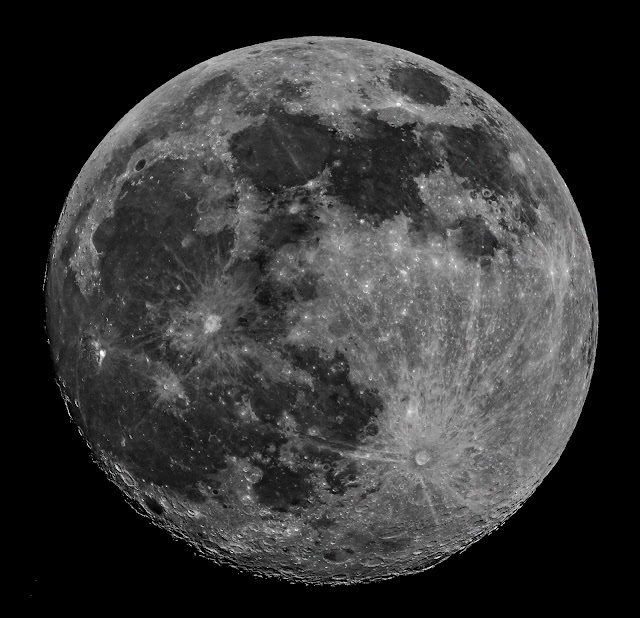
Full Moon - 12 January 2017

I got one shot at tonight's full moon before it was covered in clouds. When the sun, moon and earth all line up at full moon then we get the highest (and indeed lowest) tides which are called 'spring' tides (nothing to do with the time of year!). In fact it takes a bit of time for the enormous mass of water to move, so the spring tide will actually occur a couple of days after the full moon.


Birders are always very keen to know about the current phase of the moon, because some of the best shoreline birding is done on high tides because they force wading and other birds to roost closer to the land. Where there are salt marshes, the land creatures that inhabit them are also forced to move further inland and this can often produce the spectacles of raptors and owls hunting and catching them with views much closer than normal.