Tuesday, 27 December 2022

Review of 2022

Some of my better images from 2022. I didn't think I done that much this year, having focused mainly on planetary imaging, but in the early part of the year I did do some work on nebulae. 

From left to right and top to bottom we have:

  • The California Nebula, which supposedly resembles the shape of the state
  • Mars showing its north polar ice cap of frozen carbon dioxide
  • The Flaming Star anthem Tadpole Nebulae with the smaller small spider Nebula
  • Saturn when it was close to opposition
  • The famous Horsehead Nebula and with the Flame Nebula below it
  • Jupiter showing cloud bands
  • The Jellyfish Nebula
  • A so-called 'mineral' moon
  • The Christmas Tree Nebula with the Cone Nebula st the top
  • The sun showing at least seven active regions or sunspots
  • The Soul Nebula
  • The Rosette Nebula in the false Hubble Palette colour

And here's a 2023 calendar with all these images for you to print out if desired:


Tuesday, 20 December 2022

To Do List (20/12/22)

 I'll start my updates by creating a to do list of my images since March 2022 in reverse chronological order.

December 2022

  • Rosette Nebula
  • Orion Nebula
  • Sunspots
  • Moon
  • Jupiter (2/10/22)
  • Mars (inc lunar occultation)
  • Saturn

November 2022

  • Andromeda Galaxy (25/11/22)
  • Heart Nebula
  • North America Nebula
  • Moon
  • Jupiter
  • Saturn
  • Mars
  • Uranus Occultation
  • First Andromeda - wide

October 2022

----------------------------------------------------------

Photos still to post:

Sept

  • Astro 17/9
  • Jupiter 16/9
  • Moon and Planets 15/9
  • Sunspots 7/9
  • Llanddwyn 7/9

Aug

  • Moon 24/8
  • Moon 25/8
  • Moon 27/8
  • Moon and Planets 26/8
  • Moffat 10/8
  • Jupiter, Saturn &DSO's 12/8
  • DSO and Planets 2/8
  • Dunstan Hill 9/8 and 13/8
  • Sunspots 29/8
  • Jupiter and Saturn 27/9

July

  • Pacman and Veil nebula 18/7
  • ISS and Moon 19/7
  • Elephant's Trunk 17/7
  • ISS, Jupiter and Saturn 17/7
  • ISS and Moon 16/7
  • Moon 15/7
  • Dumbell 15/7
  • Crescent 16/7
  • Andromeda 8/7
  • Eagle Nebula 7/7

June

  • Sunspots 29/6
  • Moon, Saturn and Jupiter 26/6
  • NGC 7000 26/6
  • Moon 21/6
  • Moon 20/6
  • Moon 17/6
  • Moon and Antares 15/6
  • Moon 14//6
  • Partial Solar Ecli[se 10/6

May

  • Sun
  • Moon
  • Rivi
  • ISS

UPDATE TIME !!!


I can't believe that I haven't updated this blog since March 2022 - how time flies.  Unfortunately it's not been a very productive year mainly due to the long stretches of poor weather and opportunities only arising at inopportune moments. 

The main thing that happened this year was that I bought a second hand Celestron NexStar 6SE telescope, a ZWO ASI 224 planetary camera, a ZWO atmospheric dispersion corrector (ADC) and a 2.5x PowerMate (Barlow) for planetary work and so that's what I've mainly focused on for much of the year. It's been another learning curve as planetary imaging is quite unlike deep sky imaging, but I have had some successes and I've managed to produce my best ever images of Saturn, Jupiter and Mars. Still a lot of work to do there though.

In the last couple of months I've been very fortunate to have had the loan of a William Optics WhiteCat 51 widefield telescope off my friend and fellow L.A.S. member Mark Hellaby, who has very kindly let me borrow it for quite a while now as he focuses on other projects in his newly built observatory.  I was mainly hoping to put it to good use at a 'Star Party' in darkest Dumfries and Galloway in November, but very poor weather meant I only managed one night of imaging and one target, Andromeda (shown here).  However, since returning home I have had a few more sessions with it in my back garden and improved my existing images of several widefield deep sky objects.

So, without more ado, I'll set about updating this blog with images I've taken since March and I'll be putting them in chronological order according to the dates I took them.

Friday, 16 December 2022

At Time of Increasing Solar Activity

Here are today's active solar regions (A.R.'s) showing more sunspots than I'ver captured before.  Although the sun emits all wavelengths of light and these combine to make white light, people are used to seeing the sun with an orange colour (caused by the scattering of all the shorter wavelengths but the atmosphere) and so I have increased the white balance to make it appear orange rather than the normal white colour my solar filter produces.

Here are some closer versions of the main sunspot groups being seen today:

A.R. 3163, A.R. 3166 and A.R. 3162

A,R. 3167 and A.R. 3160

A.R. 3165

A.R. 3168

A.R. 3163

A.R. 3166 and 3162


Thursday, 15 December 2022

The Flaming Tadpoles and Friends

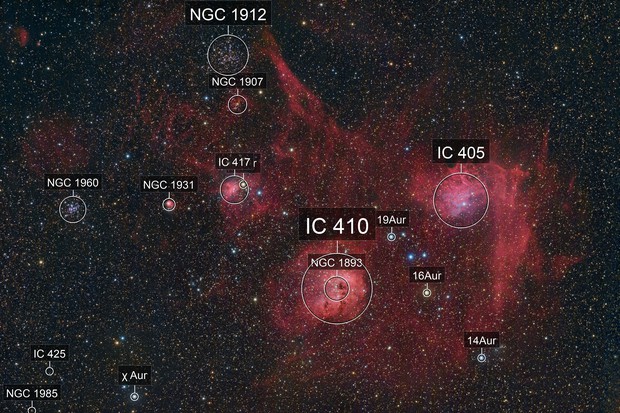
In this wide field image there are three main nebulae and some partial views of other deep sky objects.  From left to right there is IC405 or the Flaming Star Nebula, IC 410 or the Tadpole Nebula and the smaller IC 417 or Spider Nebula.

In the bottom right corner there is also part of NGC 1912 or the Starfish open star cluster.

Here's an annotated inverted version of this region of the sky:

Wednesday, 14 December 2022

The Full Veil Nebula

Until I borrowed the WO WhiteCat telescope with a focal length of 250mm, I could only ever image one section of the Veil Nebula at a time.  To get the full Veil Nebula with my scopes I would need to do a mosaic of several images and I haven't got round to trying this technique out yet.  Indeed, this is a common problem for many astrophotographers and so it's very common to see separate images of just the Western Veil (or Witch's Broomstick) and the Eastern Veil rather than the full nebula. Therefore the full Veil Nebula was high up on the list of images I wanted to take whilst I still had access to this scope.  


The Veil Nebula is easily overwhelmed by the number of stars in the region and so I used the technique of removing the stars to process the nebula and then reducing them in size and intensity before adding them back in. Unfortunately this has resulted in the very bright star (52 Cygni) in the Western Veil area becoming quite dull and so I need to redo this image sometime to bring up it's brightness and vibrance. I'm also not terribly happy with the colours so more work is needed.

Waning Gibbous Moon

 Here are some shots of tonight's waning gibbous moon:


Tuesday, 13 December 2022

Two for the Price of One!

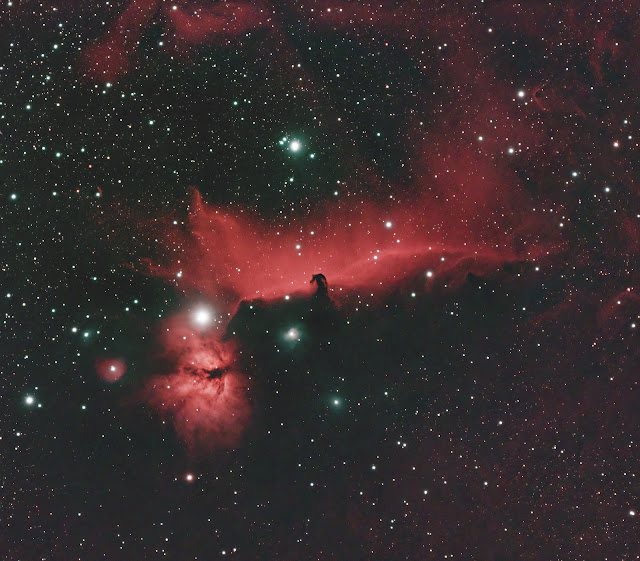
The famous Horsehead Nebula is one of my favourite deep sky targets and one I found it hard to believe I could actually image from my own back garden.  And when imaging this dark nebula in widefield, you get two for the price of one, because the Flame Nebula is also in view in the lower left corner.

The big problem with imaging this fantastic pair of nebulae is the very bright star called Alnitak to the left of the horse's head, which tends to drown everything out.  In trying to dim it's effect, there is a tendency for it to become quite dull, as it has done in my image above, so more work is needed to get the final image I so desire for my wall.


Thursday, 8 December 2022

The 2022 Lunar Occultation of Mars

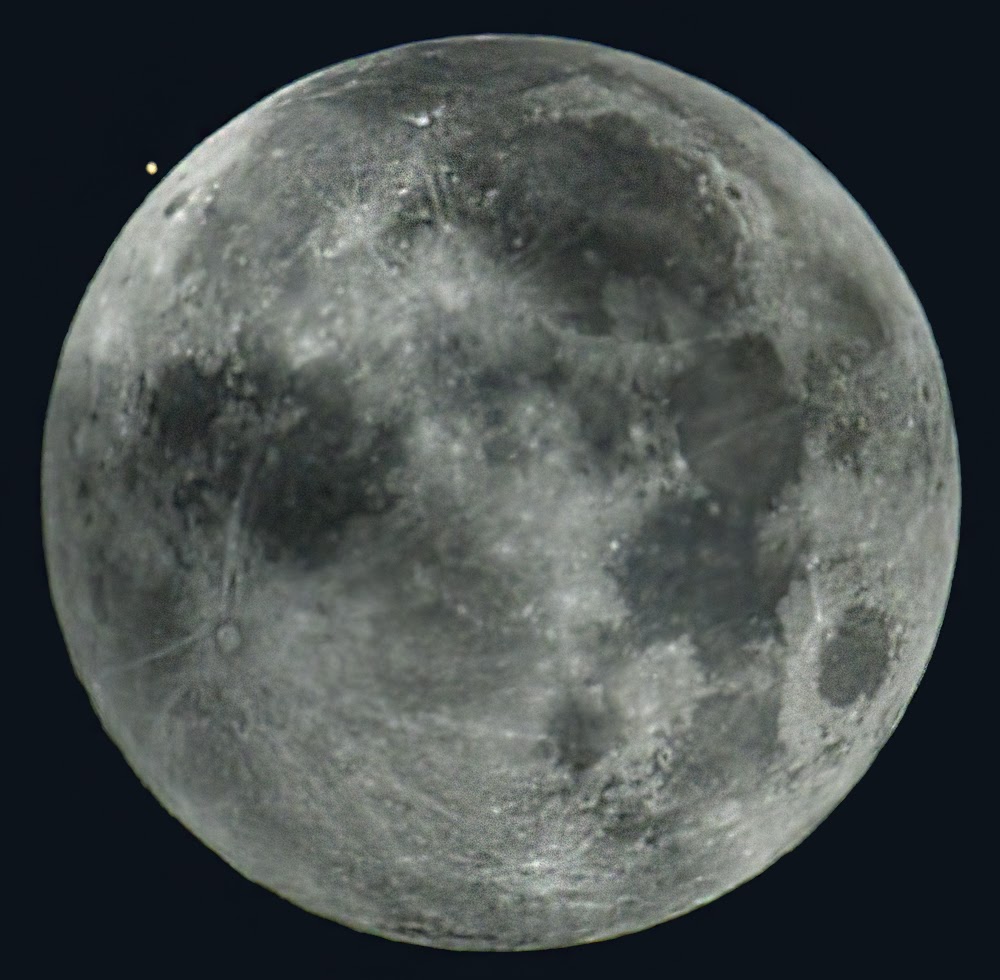
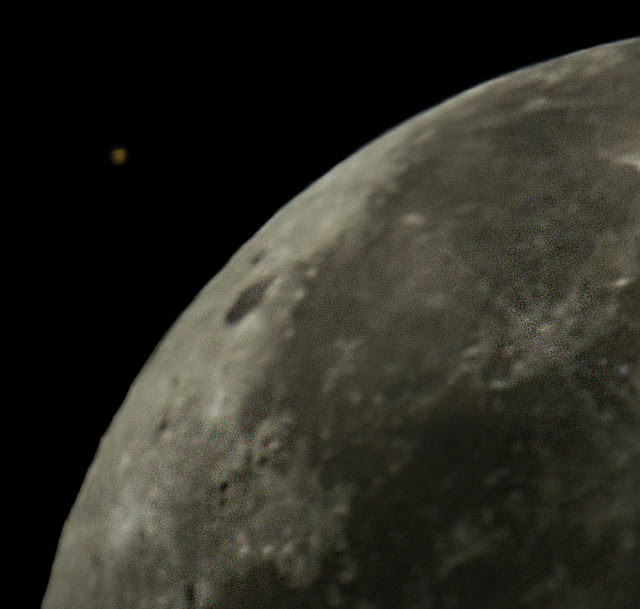
Occultation is where one astronomical object, such as a planet or moon, passes front of another one, obscuring it from being seen.  In this case, the Moon was due to pass in front of Mars in the early hours of 8 December 2022.  In addition, Mars also happened to be in opposition, meaning that the Earth was directly in line between Mars and the Sun. Opposition is when a planet appears at its brightest in the night sky.

I had so looked forward to this rare astronomical event and planned for it quite throughly, but in the end I was frustrated and foiled by the cloudy weather. I set up early in the afternoon and had quite a few practice shots during the early evening when the skies here were crystal clear.  

At first I thought I'd stay up all night waiting for the main event when Mars was occulted by the full 'Cold' Moon at around 4:45am, but in the end I decided to get a few hours sleep starting around11:45pm. When I got up at 3:14am, the skies were still clear and Mars was a lot nearer to the moon than when I had gone to bed.  However, when I returned from making a quick cup of tea, everything had changed!

The clouds had rolled in totally obscuring Mars and the Moon at times and time was running out.  I'd focused everything previously, so I wasn't concerned about that, but the exposure time was giving me real problems and I had to keep adjusting it manually with every passing cloud.  This really wasn't easy and was certainly very frustrating.

Consequently, I couldn't see Mars at the all important moment of occultation, so I just left the camera video running whilst I hoped for the best.  I was also trying to take some manual single shots with my DSLR and big lens in a sort of belt and braces approach.  In hindsight this wasn't such a good idea as my attention was constantly switching between the two systems.

At first I thought I'd totally fluffed it, but with a considerable amount of processing I managed to resurrect these two shots from the stacked video.  They're quite disappointing really but they are all I've got and at least I witness the event.  


My best shot probably came after the occultation had finished and Mars was on its way to set in the western sky. You can see how cloudy it was from the colours in the sky and the lack of clarity in the Cold Moon's surface features.


Tuesday, 6 December 2022

If You've Got Heart, You Gotta Have Soul!

The Soul Nebula is partner to the Heart Nebula in the constellation of Cassiopeia.  The Heart Nebula was my first go at using Mark Hellaby's WhiteCat 51 telescope last month. Unfortunately, not even the WhiteCat is wide enough to capture both in one image and so I had to image them separately. Tonight's target was the Soul Nebula - well, if you've got Heart, you gotta have Soul!

I also managed a bit of time on the Elephant's Trunk Nebula on the same night. It's nice to see it in a widefield setting as my previous images wit a narrower field of view concentrate just on the Elephant's Trunk itself.


Sunday, 13 November 2022

The North America and Pelican Nebulae in Cygnus

This is another pair of widefield targets that I can't achieve in a single image with my own telescopes. The so-called North America Nebula on the left of this image has an uncanny resemblance to North America and the Gulf of Mexico in particular, but I do find the smaller Pelican Nebula on the right much harder to resolve.


The brighter section of the North America nebula, which I guess represents California and Mexico, is known as the Cygnus Wall and it's something I want to image with my own scopes which have more focal length and a narrower field of view.

You're All Heart

My previous attempts at the Heart Nebula have never managed to capture the whole nebula due to my own scopes having to narrow a field of view (FOV).  However, Mark Hellaby has kindly loaned me his William Optics WhiteCat 51 telescope which, at 250mm, has a much wider FOV and so I am able to image some of the larger nebulae in their entirety.  My first go at using this excellent scope was to image the Heart Nebula.


And it really does look like a science textbook cross section of the human heart!

Sunday, 27 March 2022

Catching up with Messier 109 - A Spiral Galaxy

It's been quite a while since I updated my blog, nearly a year in fact. The latter half of last year and particularly the winter period wasn't very good for astrophotography because of the weather - we seemed to have weeks and weeks of cloudy skies with very few breaks. The winter constellations like Orion will have to wait for another year! 


It was very similar at the start of this year too, but things got a little better in February and March and I managed to make some progress in my images and image processing techniques. I've managed to keep posting a few things to my Flickr account throughout this time, and now I'm turning to my blog. I'm going to work from today backwards to post all the images I've taken since last May.

So here's an image of Messier 106 (also known as NGC 4258) whcih is an intermediate spiral galaxy in the constellation of Canes Venatici. It was discovered by Pierre MĂ©chain in 1781. M106 is about 22 to 25 million light-years away from Earth and contains an active nucleus classified as a Type 2 Seyfert. The presence of a central supermassive black hole has been demonstrated from radio-wavelength observations of the rotation of a disk of molecular gas orbiting within the inner light-year around the black hole. A Type II supernova was observed in M106 in May 2014. Here's a closeup view of M106 cropped from the above image. It clearly shows the galaxy's spiral arms.


And finally this widefield view of my image has been annotated in www.astrometry.net and shows how rich the region is in deep sky objects including NGC 4217, a possible companion galaxy of M106.

Friday, 25 March 2022

Messier 51a - The Whirlpool Galaxy

Messier 51a, also known as the Whirlpool Galaxy or NGC 5194, is an interacting grand-design spiral galaxy with a Seyfert 2 active galactic nucleus. It lies in the constellation of Canes Venatici at a distance of 31 million light-years from Earth. It was the first galaxy to be classified as a spiral galaxy. 

It was discovered in 1773, by Charles Messier while hunting for objects that could confuse comet hunters, and was designated in Messier's catalogue as M51. Its smaller companion galaxy, NGC 5195, was discovered in 1781 by Pierre MĂ©chain, although it was not known whether it was interacting or merely another galaxy passing at a distance. In 1845, William Parsons using a 72-inch (1.8 m) reflecting telescope in Ireland, found that the Whirlpool possessed a spiral structure, the first "nebula" to be known to have one. These "spiral nebulae" were not recognized as galaxies until Edwin Hubble was able to observe Cepheid variables in some of these spiral nebulae, which provided evidence that they were so far away that they must be entirely separate galaxies.

The advent of radio astronomy and subsequent radio images of M51 unequivocally demonstrated that the Whirlpool and its companion galaxy are indeed interacting. Sometimes the designation M51 is used to refer to the pair of galaxies, in which case the individual galaxies may be referred to as M51a and M51b.


The galaxy and its companion, NGC 5195, are easily observed by amateur astronomers, and the two galaxies may be seen from dark sky sites with binoculars. The Whirlpool Galaxy has been extensively observed by professional astronomers, who study it to understand galaxy structure (particularly that associated with the spiral arms) and galaxy interactions. This second version of my image is one that has been calibrated photometrically in Siril to give the true star colours.


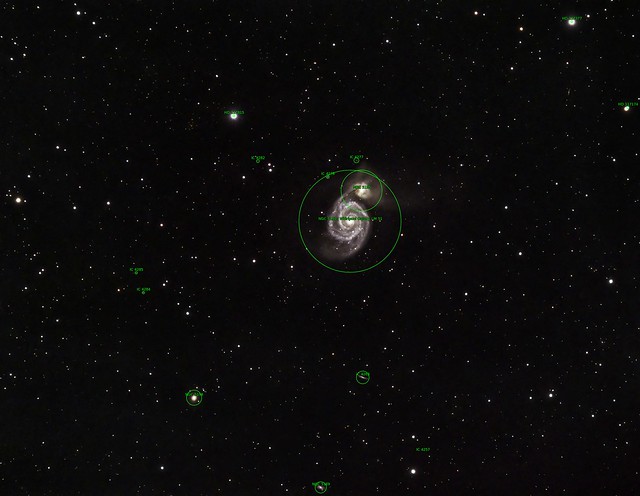
Here's a widefield shot of the region which has been annotated in www.astrometry.net.

Thursday, 27 May 2021

One Step Closer

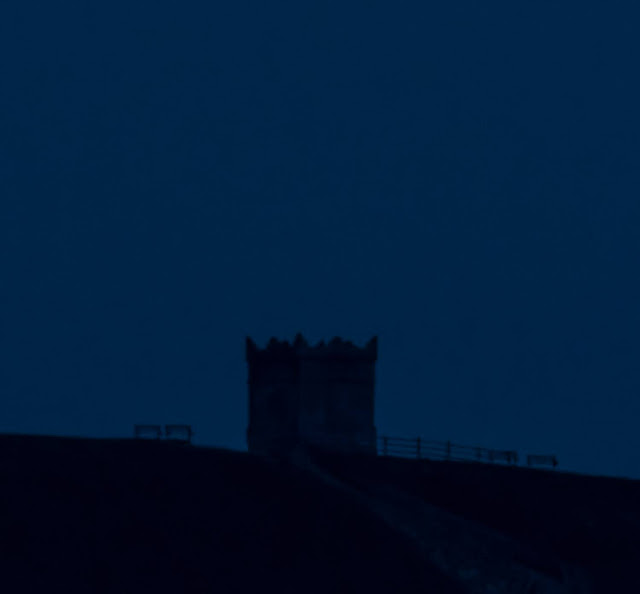
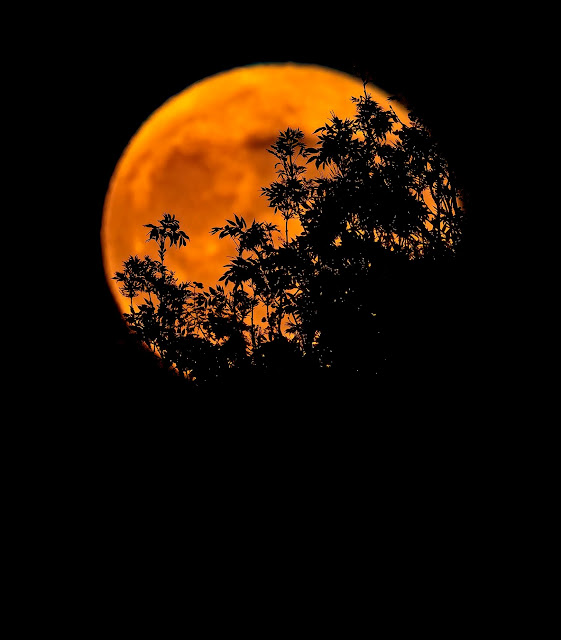
Tonight I got one step closer to achieving the lunar image I desire from Rivington Pike.  My aim is to take a photograph of the full moon rising from behind the pike, with the Pike Tower on top being silhouetted against a large, bright moon.

I've tried a couple of times now and got it wrong on both occasions - however I learnt valuable things in doing so, and the most important thing is finding the right location from where to take the shot.  This may seem obvious, but it's nothing like as easy as it seems!

I used an iPhone app called PhotoPills to plan the shoot, because it tells me where and the moon will be rising each day and gives me an indication for the line of sight from where i will be able to see it.  Of course, it's not perfect as it can't foresee a stand of large trees or a mobile phone mast being in the way.

So armed with a few ideas, I drove up to Rivington at around 9:30pm to get set up and wait for the moon to rise at 11:13pm.  At this time of year it doesn't go completely dark and so, even with no street lighting or significant other lights, it's quite easy to see even in reasonably remote locations.

My first mistake was to realise that although the moon rises at a certain time, the times are for rising above the horizon -  being in the low west Pennine hills, there's no horizon in sight, and it takes much longer for it to appear above the hill tops. So I had another hour or so to wait after the time indicated.

During this waiting time the clouds came and went - at some point I could see stars and the Plough constellation and at other times I couldn't see anything.  The International Space Station passed overhead at around 10pm, but I was set up for the moon, so I didn't attempt to photograph it.

My second mistake was not to bring a torch because, even though I could see where I was standing and walking, finding the camera controls in the dark can be fiddly. I usually have a head torch with me but for some reason I didn't think to bring one tonight.

I took some test shots of the Pike Tower before it got near moonrise time and then waited, and waited, and waited. I actually started to wonder if it was so cloudy in the east that the moon had risen but I couldn't see it. 

Meanwhile, cars were whizzing by me at a fairly constant rate (it's the only road in this area), probably wondering what this lunatic (ged'dit?) was doing.  With my car up a slight verge at the entrance to a farm gate, I must have looked as if I had broken down, but only two cars stopped to see if I was OK, one of which held three beautiful young ladies (they looked like models), who asked me what I was doing and who were very interested to learn when I explained. Ah, if only I was 30 years younger!

Eventually the full moon did appear through hazy clouds, lighting up a patch of sky with an errie glow. It was a little more to the right of the Pike Tower than I wanted and so I lifted the tripod with the camera on it and walked further up the road.  The moon rises pretty quickly and by the time I'd got setup in a new location, it was higher in the sky. It was also much cloudier and so there was no chance of a decent shot tonight.

Never mind I thought, there's a full moon every month, although not a Supermoon like this one.  I was pleased to have got to my best location yet and now that I've found this, I can pop out again when the weather is better and I'm sure I'll eventually get the shot I want.

Wednesday, 26 May 2021

Super Flower Blood Moon

Super Flower Blood Moon (26/5/21)
This is the second and last of 2021’s two 'Supermoons' and it's also known as the 'Flower Moon' as it appears at the time that many flowers start to blossom.
A supermoon happens when a full moon occurs at the same time, or close to the time, that the moon reaches its closest point to the Earth – a point called perigee.
As well as being a supermoon, the moon also experienced a lunar eclipse (although not visible in the UK) giving it a reddish tinge and turning it into a so-called ‘Blood Moon’. 
A lunar eclipse happens when the moon’s orbit moves in front of the Earth’s shadow, preventing the sun’s light from reaching it – instead, light from the Earth’s sunrises and sunsets illuminates the moon, giving it its ‘blood’ red appearance. 
The hue and depth of the red colour is dependent on a number of factors, like the amount of dust in the atmosphere at the time of the eclipse. If there is a particularly high amount of dust in the atmosphere, the higher frequency blue waves will be blocked, allowing through the lower frequency ‘red’ coloured light waves. So the super blood moon’s appearance can range from a deep, fiery red to its regular grey self.
Supermoons appear to be bigger and brighter and this one will continue to look full to the naked eye for a couple of days on either side of May 26.

Wednesday, 19 May 2021

Another International Space Station Encounter

Tonight saw a low, bright pass of the International Space Station which was viewable from my back garden in Tyldesley, Greater Manchester. It passed from west to east at 60 degrees with a magnitude of -3.4 which is very bright.


X and V on the Moon'

At certain times, the moon shows features which have been given names according to their shape.

The Lunar X is a clair-obscur or chiaroscuro effect in which light and shadow creates the appearance of a letter 'X' on the rim of the Blanchinus, La Caille and Purbach craters.

The X is visible only for a few hours before the first quarter, slightly below the lunar terminator. Above the X, the Lunar V is also visible, formed by Ukert crater and several other small craters.


Here's a labelled version: