I popped out to the
Rosette and Heart for a swift session last night! It's been so long since I've done any deep sky imaging (due to the appalling night time UK weather) that I've forgotten almost everything about how to do it! I also thought I'd use the session to reacquaint myself with
guiding as I haven't used it that often and up to a point it was a successful trial
So here's a couple of narrowband images from last night to help ease myself back into the game. I started with the Rosette Nebula (Sh2-275 or Caldwell 49), the centre of which contains the open star cluster NGC 2244 or Caldwell 50. It's an H II region located near one end of a giant molecular cloud in the Monoceros region of the Milky Way. The open star cluster is closely associated with the nebulosity, the stars of the cluster having been formed from the nebula's matter.
The Rosette Nebula has been said to resemble a human skull, and is sometimes referred to as the 'Skull Nebula' although in this image the skull has been rotated 90 degrees to 'look' upwards.
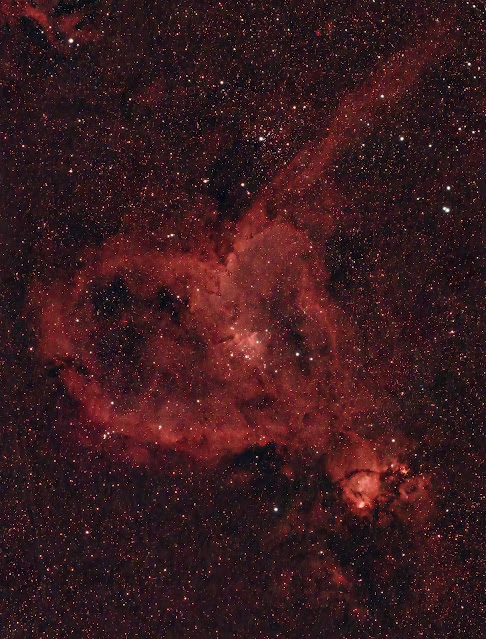
My second target was the Heart Nebula (IC 1805 or Sh2-190) in the constellation of Cassiopeia which is another emission nebula, and was discovered by William Herschel on 3 November 1787. It displays glowing ionized hydrogen gas and darker dust lanes.
The brightest part of the nebula (a knot at its western edge) is separately classified as NGC 896, because it was the first part of the nebula to be discovered. The nebula's intense red output and its morphology are driven by the radiation emanating from a small group of stars near the nebula's center. This open cluster of stars, known as Collinder 26 or Melotte 15, contains a few bright stars nearly 50 times the mass of the Sun, and many more dim stars that are only a fraction of the Sun's mass.
The Heart Nebula is also made up of ionised oxygen and sulphur gasses, responsible for the rich blue and orange colours seen in some narrowband images. The shape of the nebula is driven by stellar winds from the hot stars in its core. The nebula also spans almost 2 degrees in the sky, covering an area four times that of the diameter of the full moon.
Acquisition Details
- William Optics WhiteCar 51 (kindly lent by Mark Hellaby)
- Sky-Watcher EQ6-R Pro equatorial mount
- Altair Astro 294C Pro Tec cooled colour camera
- Optolong L-eNhance narrowband filter
- Partly guided by PHD2 using a ZWO 224mc on a Sky-Watcher finder scope
- Captured in Astro Photography Tool
- Stacked and light pollution removal in Astro Pixel Processor
- Processed in Adobe PhotoShop with Topaz AI Denoise, Sharpen and AstroFlat plugins and Astronomy Tools actions