Thursday, 23 April 2020

My Astrophotography Equipment

Over the last couple of days I've been asked many times on various Facebook posts what equipment I use to take my photographs.  As I can't possibly answer everybody individually,  I've decided to do a post on it here. I hope I missed nothing out, but if I have I'll update it as necessary.


Hardware
  • Nikon D500 crop sensor camera for shots of the moon, planets, galaxies and nebulae
  • Nikon D810 full frame camera for widefield shots of stars and constellations
  • Nikon 500mm f/4E FL lens for the moon, planets, galaxies and nebulae
  • Nikon TC-20E II 2x teleconverter for magnification where necessary
  • Nikon TC-14E III 1.4x teleconverter  for magnification where necessary
  • Nikon intervalometer for taking sequences of shots
  • SkyWatcher HEQ5 Pro GOTO mount with SynScan controller and tripod for tracking the stars
  • Neewer right-angled viewed for polar alignment
  • Bahtinov mask to aid focusing on stars
  • SkyWatcher 12v 17Ah battery power pack to power the mount
  • Red headlight to see in the dark without losing night vision
  • Compass to align the tripod north
  • Spirit level to level the tripod
  • Laptop computer for processing and uploading to Facebook


Software
  • Deep Sky Stacker (free) to stack shots together
  • Adobe PhotoShop Elements 14 (paid, cheapish) to process the stacked shots and bring out detail
  • Adobe PhotoShop CC (paid, expensive) to process the stacked shots and bring out detail

Sustenance on cold nights
  • Lots of cups of tea
  • A packet of biscuits or crisps
  • The occasional single malt whisky

Set up procedure
  • Level the tripod and point it north
  • Attach the mount and counterbalance weights
  • Attach the camera and balance in two axes on the mount
  • Polar align the mount (make it point at Polaris, the north star)
  • Setup SynScan controller with time, date, location coordinates etc
  • Use Syncs to do a 'Two Star' align - move the mount to two known stars to calibrate it

Finding a target and taking shots (quick version)
  • Select a target using the SynScan controller
  • Move the mount to the target's position
  • Put the camera in manual mode and chose the aperture and ISO
  • Take a test shot to see if the target is centred in the frame
  • Check the focus using the Bahtinov mask
  • Use the hand controller to adjust the mount position if necessary
  • Set the exposure time and number of shots, e.g. 30 shots (known as subframes or subs)
  • Start the sequence of shots - usually at least 20 and as many as 50
  • Go inside and have a cup of tea

Processing and Sharing
  • Copy the finished subs off the camera and onto the laptop computer
  • Stack the shots using Deep Sky Stacker
  • Process the final stacked shot to bring out the fine detail and colours
  • Upload the finished shot to Facebook or a similar internet site
  • Wait to see the response

I will add some posts shortly outlining the following processing techniques:
  • Stacking for increasing the detail and reducing image noise
  • Taking darks, flats and bias frames for noise reduction and better detail
  • Image processing

Hope that helps

Thursday, 16 April 2020

My Third All-Nighter

Here are some shots from my third All-Nighter this month where I stay up until the wonderful Dawn Chorus of birds start singing in order to view Jupiter, Saturn, Mars and the Moon rising in the south east.  But before that happens I spent the night taking shots of Deep Sky Objects.

M81 and M82 - Bodes Galaxy and the Cigar Galaxy

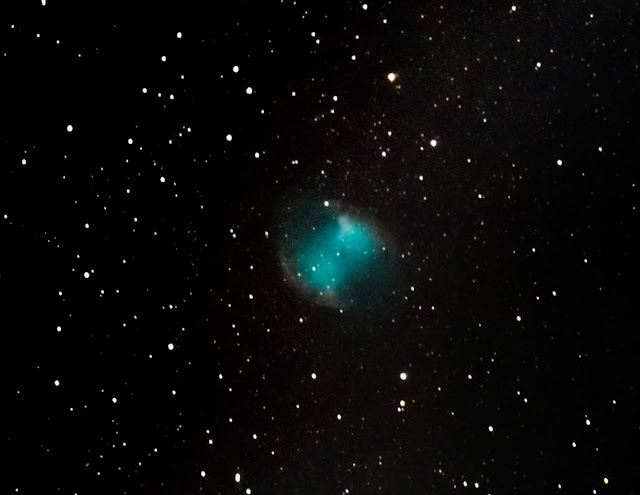
M27 - The Dumbbell Nebula
Can you see anything?
Right to Left - Jupiter, Saturn, Mars and the Moon does below.
Jupiter showing some very faint cloud bands
Saturn - nice to see the separation between the planet and it's rings
Mars - well at least it's a bit reddish!
The waning crescent moon

Sunday, 12 April 2020

Waning Gibbous Moon - 12/4/20


A single frame handheld shot of the waning gibbous moon at 2am this morning as seen from Tyldesley in Greater Manchester. Taken with a Nikon D500, Nikon 500mm f/4 lens and a Nikon 2x teleconverter.

Sunday, 5 April 2020

Venus and the Pleiades

Venus and the Pleiades - sounds like the name of a pop group doesn't it? Well this was going to be one of the highlights in the night sky this month and so I was very keen to photograph it.

Frustratingly, the clouds rolled in on best night when Venus would be in front of this open star cluster (3/4/20), so I had to make do with the following night (4/4/20).


I started by taking some photos of the waxing gibbous moon before it went completely dark. There are nice views of the Tycho and Copernicus lunar impact craters here. It was from this photo that I realised how far the ejection debris was flung from Tycho after it was hit by a large meteorite.


Venus was my next target, also before it went fully dark. I wanted to try to show its phase as it is rapidly diminishing in size and look very crescent-like. I had to turn the brightness down a long way to show it and this has made the sky look darker than it actually was.


Here's Venus with the Pleiades star cluster to the lower right.  Whoever named this asterism the 'Seven Sisters' clearly couldn't see all the stars - there are many more than seven!  Here's a quote shamelessly lifted from a post by Paul Richardson.
Every eight years or so, Venus passes across the line of sight of the Pleiades star cluster. It's not exactly passing "through" the star cluster, since the Pleiades are about 88 thousand times further away from us than Venus is. Since Venus is at present about 107 million Km away, that make the Pleiades a long way from home. Anyway this is how they looked last night. So mind boggling, but so beautiful.

Thursday, 2 April 2020

L.A.S. Inaugural Meeting in Bowland


The Leigh Astro Society (L.A.S.) had its inaugural meeting in the Forest of Bowland in Lancashire on the 1st October 2019.  This trip to our nearest 'Dark Sky' location had its seeds in a casual discussion with two birding friends (George Pike and Paul Richardson) from Leigh Ornithological Society (L.O.S.) when I discovered that George had always wanted to see Andromeda and that Paul had beed an astronomer since his early youth. As Paul had an old telescope lurking in the back of his wardrobe, I decided to arrange a trip and on that night the L.A.S. was born. The founding members are Paul, George and myself with Paul being duly elected as Chairman of the Society because he has telescopes and knows stuff.

The actual idea to form a 'Society' all started off as a bit of a joke whilst we were out there, with me making up the initials to be the same as our esteemed birding Society. We'd recently been given a talk by one of the L.O.S.'s founding members who explained how the Society started nearly 50 or more years ago.  So in a comedy parody of that talk I started saying ...
"It was in the winter of 2019 when three intrepid lads forayed into deepest and darkest Lancashire in search of Andromeda that the foundations of the L.A.S. were laid"
I also made fun of the fact that in a recent radio interview with one our L.O.S. members, the presenter couldn't the Society's name right (well it is rather a mouthful) and so some sarcastic suggestions included the Leigh Astrophenomical Society and the Leigh Astronomological Society before we eventually settled on something short and sweet - the Leigh Astro Society.

Anyway, it was on that night that George and I had our first views of Andromeda and Saturn thanks to Paul's help.  We were based in a small lay-by along the BXXX out of Waddington and it was pretty dark - there was just a distant glow from Preston to the west. But we could see so many stars compared to our suburban homes in Leigh and Tyldesley, Greater Manchester.

These photos are not much, but they mark my initial steps into the field of Astrophotography. Some would say it's a minefield, others a wonderful hobby. I've already experienced both!

Work in progress - ignore the notes below.


Notes ....

George Pike, Paul and I had a great night viewing the skies above Bowland and this inspired me to look for a tracking mount so that I might do longer exposures of deep sky objects (DSO's) such as galaxies and nebulae as well as the Milky Way.

We had a great night and George (Pike) got to see Andromeda (one of his long-felt needs) and I reawakened my interest in the starts all under the superb guidance of our resident astronomy guru Dr. Paul Richardson. We also saw Saturn, the Hyades and Pleiades and a host of other stars which just can't be seen from suburban areas.

Update:
I've since set up a light-hearted, fun Facebook group which all those with an interest in astronomy, the night sky and astrophotography are welcome to join. We also have a WhatsApp group for reporting interesting sightings, aurora alerts and anything else that's relevant.

Wednesday, 18 December 2019

Early Riser!

I couldn't sleep last night so, as the hazy moon was shining through my window, I got up at silly o'clock this morning and waited for a break in the clouds. Eventually it came and I took some shots of this waning gibbous moon. This one has turned out to be one of the sharpest moon photos I have ever taken.


But as the sky cleared I decided to also have a go at some tracked shots and I was quite pleased to get my first image of the Ring Nebula (Messier 57) even though it's far from perfect. The Ring Nebula (is a planetary nebula in the northern constellation of Lyra. Such objects are formed when a shell of ionized gas is expelled into the surrounding interstellar medium by a star at in the last stages of its evolution before becoming a white dwarf.

This is just a single tracked shot taken with a 500mm f/4 lens plus 1.4x teleconverter on a crop sensor camera - 700mm ISO 640 f/8 @ 3 minutes. Yes, it really is that blue.


My next target was Bode's Galaxy (Messier 81) and the Cigar Galaxy (Messier 82) which can both be imaged in one shot - can you guess which is which from the photograph below?

Bode's Galaxy is a spiral galaxy about 12 million light-years away, with a diameter of 90,000 light years, about half the size of the Milky Way, in the constellation Ursa Major. Due to its proximity to Earth, large size, and active galactic nucleus (which harbours a supermassive black hole), Messier 81 has been studied extensively by professional astronomers.

The Cigar Galaxy is a starburst galaxy approximately 12 million light-years away in the constellation Ursa Major. A member of the M81 Group, it is about five times more luminous than the whole Milky Way and has a centre one hundred times more luminous than our galaxy's centre.

Next onto the Hercules Globular Cluster (Messier 13). This globular cluster consists of several hundred thousand stars in the constellation of Hercules. It's sometimes called the Great Globular Cluster in Hercules.

Arcturus (below) is a red giant star in the Northern Hemisphere of Earth's sky and the brightest star in the constellation Boötes (the herdsman). Arcturus is also among the brightest stars that can be seen from Earth. Astronomers say Arcturus will end up as a white dwarf at the end of its life.


Vega (below) is the brightest star in the northern constellation of Lyra. This star is relatively close at only 25 light-years from the Sun, and, together with Arcturus and Sirius, one of the most luminous stars in the Sun's neighbourhood. It is the second-brightest star in the northern celestial hemisphere, after Arcturus.

Vega has been extensively studied by astronomers, leading it to be termed “arguably the next most important star in the sky after the Sun”. Vega was the northern pole star around 12,000 BC and will be so again around the year 13,727. It was one of the first stars whose distance was estimated through parallax measurements.


And finally a quick snap of the Whirlpool Galaxy and friend (Messier 51). The Whirlpool Galaxy was the first galaxy to be classified as a spiral galaxy. It lies in the constellation Canes Venatici where it is interacting with a smaller companion galaxy. Sometimes the designation M51 is used to refer to the pair of galaxies, in which case the individual galaxies may be referred to as M51a and M51b.

But by now it was starting to get light so I struggled getting a decent image of these two galaxies. This is definitely a deep sky object to which I will be returning.


Individually, some of my images don't look much, but when viewed as a collection they start to show how varied and immense the universe really is. And boy do the constellations look different so early in the morning!

Wednesday, 11 December 2019

Almost a Full Moon!

It has been a longhand ambition of mine to get a photo of a full moon near or behind the pithead winding gear at Astley Green Colliery. I have tried several times but it didn't take long to realise that I'd need to do a blended composite of two images to get the correct exposure and desired effect.

Astley Green Colliery has the only surviving headgear and engine house on what was the Lancashire coalfield. The headgear is made from wrought iron lattice girders with rivetted plates at the joints. It has two large and one small wheel mounted at the top. It is nearly 30 metres (98 ft) high and was built by Head Wrightson of Stockton-on-Tees and completed by 1912.


In the winding house there is a twin tandem compound steam engine made by Yates and Thom of Blackburn who supplied 16 Lancashire boilers. Its engine house has the largest steam winding engine used on the coalfield. The 3,300 horse power twin tandem compound engine was built by Yates and Thom in Blackburn.


When I got home I decided to get some (almost) full moon shots from my front garden before the clouds rolled in again.

Monday, 11 November 2019

Three Blokes in a Transit

Three Blokes in a Transit


The start of the 'Transit of Mercury' as seen from Ty Mawr Country Park, Rhuabon near Wrexham in North Wales on Monday 11 November 2019.

This story starts with a little fun astronomy group (Leigh Astro Society) that we set up back in October when three of us visited a dark sky location in the Forest of Bowland in search of Andromeda. The founding members of the L.A.S. were Paul Richardson, George Pike and myself.  Following this meeting I set up a Facebook group and the online membership has now grown to seventeen people, with around five people regularly posting photos or useful information for the group.

One of these posts concerned the approaching 'Transit of Mercury' which is a reasonably rare event and so some of us got interested in seeing and hopefully photographing it.

To do this we'd need solar filters for our 'scopes and camera lenses. Paul, who is the only true astronomer amongst us, had already made one previously for a telescope, which he then adapted to fit his camera.

I, on the other hand, am a compete novice to astrophotography and when I realised that Paul's filter wouldn't fit my camera so I couldn't borrow it, decided to make my own at the very last minute - two days before the transit in fact with one of those being a Sunday.

I'd left it too late for the required Baader AstroSolar Safety  Film to be delivered from an online source, and so after a frantic morning of phoning up every nearby camera and telescope shop without any luck, I decided I'd have to make the three-hour round trip to Rother Valley Optics near Sheffield to ensure that I got some in time.


Anyway, I did the trip, got the film and spent Sunday afternoon making two filters, one for my 500mm lens and the other for my 300mm lens just in case there were any issues.  I was reminded of the old Blue Peter programmes as I cut the required shapes out of card and then used double-sided tape and sticky-backed plastic to fix them together. It was tight making two filters out of a single piece of A4 film, but at nearly £20 a sheet I wasn't going to waste any of it!


Filters made, it was time to decide where we'd be going to get the best chance of seeing the sun.  The weather forecast wasn't good with a front bringing cloud and rain over the North West during the day.  Paul decided that North Wales would be the best place to try, with a couple of possible locations in mind, the first being Ty Mawr Country Park in Rhuabon near Wrexham. We turned up at George's house at 10am and by 10:15am we were on our way with George driving - well he had said he'd be willing to drive up to 50 miles to see the Transit and that was going to be more or less right.

One of the first photos I took of Mercury;


The small black speck on the left side of the sun isn't dust but the planet Mercury, which only passes in front of the sun every 15 years or so. Mercury is 57.91 million km away compared to the sun's 149.6 million km, so it's nearer to the Earth than the sun. It's also only 38% of the Earth's size.


It's so small that you'll need to view these fullscreen and it can't be seen with the naked eye. You must never look at the sun through bins or scopes unless you have a special solar filter which cuts out 99.99% of the light and radiation.


The actual colour of the sun is white but I increased the white balance in the first shot to make it the more familiar orange colour we see, which is caused by our atmosphere scattering the light.

It definitely seemed to become more orange as it descended below the hills.

And so to bed ...


The founding members of the Leigh Astro Society.


Monday, 7 October 2019

Waxing Gibbous Moon - 7 October 2019


The waxing gibbous moon as seen from my front garden in Tyldesley. Waxing means that it's getting bigger. Gibbous refers to the shape, which is less than the full circle of a full moon, but larger than the semicircle shape of the moon at third quarter.


Friday, 20 September 2019

Shooting for the Stars!

I've been interested in taking photographs of the night sky for a few years now, but other than taking a few shots of the sun and moon on various eclipses and at other notable times, I've never got my act together to shoot for the stars. Having seen a number of Milky Way photographs coming out of North Wales this year, I decided it was time to try to get some myself.


So after I'd spent the day in Snowdonia with Pete Lawless, I decided that I'd stay on and try for some Milky Way shots myself. The original idea was to meet up with the two most prolific night sky photographers in the area, but somehow the plans went awry and I was contacted on what proved to be an excellent night for photography.

So I was left to my own devices and I ended up revisiting a place that Pete and I had been to during the day to do some landscape shots - Cwm Idwal. I decided on this as I had already familiarised myself with the landscape and footpaths and this was going to be very useful as I wandered around in the dark.

I'd prepared reasonably well by packing a couple of torches and warm clothing and I'd recently bought the PhotoPills app for my phone which helped to show where the Milky Way would be in the sky and at what time. I'd also be practicing taking photos in the back garden to get familiar with my camera controls when you can't really see your hands in front of your face.


Surprisingly though, it wasn't quite as dark as I'd expected because there were some lights in the nearby cottages and the odd car passed by on the A5 road below me. But what really opened my eyes as I stood on the bridge looking over the Afon Ogwen Falls, was the number of people who were wandering about in the dark at 11pm at night! There were headlamps camping on top of Pen yr Ole Wen and Tryfan, lights coming down the steep slopes of both mountains and people going up to Cwm Idwal to wild camp overnight.


So at the end of a very long day, I went back to the car hoping to find a pub on the way home as I was starving and desperate for a pint of lager shandy. But I'd left it too late and all I could find was a Tesco Express which I just managed to get in before closing. I bought two drinks and a sandwich and drove home hoping that some of the shots would be half decent. A great day out and it was quite an experience, believe me.